 Mushroom Matter
sharing mushroom news with care
Mushroom Matter
sharing mushroom news with care
Menubar












GrowTime at NAMC 2026 in Montreal – innovations that boost efficiency and profitability
From June 4–6, 2026, Montreal will host the 27th edition of the North American Mushroom Conference — one of the most important events for the mushroom industry in North America. The conference brings together growers, experts, and industry leaders to exchange knowledge and discover the latest technologies supporting modern mushroom cultivation.
We are proud to announce that GrowTime will also be among the exhibitors, showcasing its solutions for professional mushroom farms. At our booth, visitors will have the opportunity to see our modern mushroom harvesting trolleys and innovative technologies designed to improve efficiency and working comfort. It will be a great chance to explore our products up close, meet the GrowTime team, and connect with mushroom industry professionals from around the world.
If you are interested in the future of modern mushroom production, this is an event you should not miss. And that’s not all… GrowTime has just entered a new market and expanded into another country. More details will be announced soon!
More about our presence at the conference here: GrowTime at NAMC 2026 in Montreal
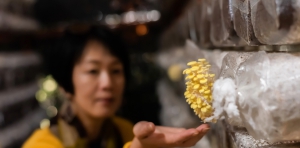
China is accelerating agrifood modernisation, with implications for mushroom production
China is increasingly focusing on the modernisation of its agrifood sector, with investments in technology, efficiency and supply chain development. These developments are not limited to major crops, but also have clear implications for sectors such as mushroom production.
As the world’s largest mushroom producer, China continues to play a key role in shaping global supply. The ongoing shift towards more advanced production systems, improved logistics and higher quality standards reflects a broader transition within the sector.
While the pace and scale differ from Western markets, the direction is clear. Modernisation is becoming a central theme, influencing how production systems evolve and how the industry positions itself for future demand.
Please read the full article here.
In a previous edition of Mushroom Matter Industry Insights, we explored how data, energy efficiency and robotics are shaping more integrated production systems.
In this edition, we look beyond technology alone and focus on three developments that are increasingly influencing the direction of the sector:
- labour strategy and workforce sustainability
- shifting market demand and specialty mushrooms
- collaboration across the value chain
Together, these themes highlight how the industry is evolving not only through innovation, but also through people, positioning and partnerships.
Labour strategy as a structural challenge
Labour has become one of the most defining factors in mushroom production.
Where it was once considered an operational topic, it is now a strategic issue that directly affects continuity, scalability and investment decisions.
Across the sector, growers are dealing with:
- ongoing labour shortages
- increasing labour costs
- the physical intensity of harvesting work
This is changing how farms are organised.
Instead of relying solely on availability, growers are rethinking how labour fits into the overall production system. This includes:
- redesigning workflows to reduce dependency on peak labour
- combining skilled workers with supportive technologies
- improving working conditions to retain experienced staff
Labour is no longer just about people, it is about creating a system that remains stable under pressure.
Shifting demand and the rise of specialty mushrooms
At the same time, market demand is becoming more diverse.
While traditional button mushrooms remain dominant, there is growing interest in specialty varieties such as oyster, shiitake and king oyster mushrooms.
This shift is driven by:
- changing consumer preferences
- increased focus on plant-based diets
- demand for new textures and flavours
For growers, this creates both opportunities and complexity.
Specialty mushrooms often require different cultivation methods, shorter shelf life management and more flexible production planning.
Rather than replacing existing production, they are increasingly seen as a complementary segment, allowing growers to diversify their offering and respond to changing market dynamics.
Collaboration across the value chain
Another important development is the growing need for collaboration.
The mushroom sector has traditionally been relatively fragmented, with clear separations between growers, suppliers, technology providers and buyers.
This is starting to change.
More and more, innovation and efficiency depend on how well different parts of the chain work together. This can be seen in:
- closer cooperation between growers and technology supplier
- data sharing across systems and partner
- alignment between production and market demand
Collaboration is not only about efficiency, but also about reducing risk and accelerating adoption of new solutions.
No single player can solve the current challenges alone.
Connecting the dots
What connects these developments is a broader shift in perspective.
- Labour is becoming part of system design
- Market demand is shaping production choices
- Collaboration is enabling innovation
Together, they show that the future of the mushroom industry is not defined by technology alone, but by how different elements are brought together.
A balanced way forward
The sector continues to move towards a model where:
- people and technology support each other
- production aligns more closely with market demand
- partnerships strengthen the overall system
This approach reflects a more mature phase of development, focused on balance, resilience and long-term viability.
Looking ahead
In the next edition of Mushroom Matter Industry Insights, we will explore several additional developments shaping the sector, including:
- the role of AI and data in decision-making on the farm
- new applications of fungi in materials and bio-based industries
- how automation continues to evolve in practical, farm-level use
It shows that real progress in the sector is not about moving faster, but about moving smarter, with the right balance between all elements.
Published by Mushroom Matter: connecting the global mushroom community through insight, innovation, and inspiration

Across different regions, regulatory frameworks are beginning to play a more visible role in the development of the mushroom and broader fungi sector.
From food safety standards to the approval of novel products and production methods, regulations are influencing how quickly new innovations can move from concept to market.
For producers and technology providers, this adds an additional layer to an already complex landscape. It requires not only technical innovation, but also alignment with evolving rules and certification processes.
While regulation is often seen as a constraint, it can also create clarity and structure within a growing industry. In that sense, policy developments are becoming an increasingly important factor in shaping the future of mushroom production and fungi-based applications.
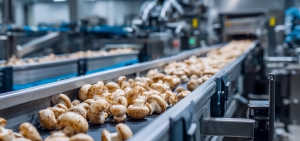
Automation in mushroom farming has long been discussed as a way to improve efficiency. What is changing now is the growing pressure behind it. Labour shortages, rising costs and increasing demands on consistency are making it more difficult for farms to rely on traditional harvesting and packing processes alone.
In many cases, labour accounts for a significant share of production costs, while at the same time becoming harder to secure. This is shifting automation from a long-term ambition to a more immediate consideration. Rather than focusing on full replacement, many growers are exploring how technology can support specific tasks and reduce dependency on manual work.
Developments like these suggest that automation is becoming less of an option, and more a necessary step in maintaining stable operations.
Please read the full article here.
Source: The Packer
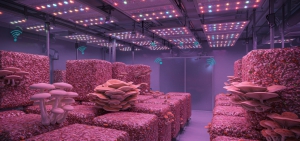
A new research initiative in Denmark is exploring how artificial intelligence and robotics can accelerate the development of fungi-based solutions.
By combining large-scale data analysis with automated experimentation, researchers aim to better understand how fungi behave and how they can be applied across different industries.
Rather than focusing on a single use case, the project looks at fungi as a broader biological platform, with potential applications in food, agriculture and pharmaceuticals. By increasing the speed and precision of research, this approach could help unlock new opportunities that would be difficult to identify through traditional methods.
While the impact on daily mushroom production may not be immediate, developments like these are likely to shape the future direction of the industry.
Please read the full article here.
Source: Innovation Fund Denmark
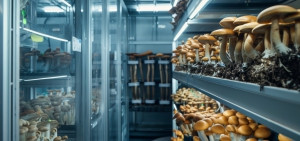
In a previous edition of Mushroom Matter Industry Insights, we highlighted a shift towards more pragmatic and integrated approaches to technology in the mushroom sector.
In this edition, we take a closer look at three developments that are gaining momentum across the industry:
- data-driven mushroom farming
- energy efficiency strategies
- the next generation of harvesting robotics
Together, these topics show how the sector is moving towards smarter, more efficient and future-proof production systems.
From intuition to data-driven growing
Mushroom cultivation has always relied heavily on experience and intuition. Skilled growers understand their crops by observing subtle changes in growth, climate and timing.
What is changing today is not the importance of that experience, but how it is supported.
Sensor technology and data platforms are increasingly being used to monitor:
- temperature and humidity at multiple levels
- CO₂ concentrations
- airflow and microclimate differences within growing rooms
- growth patterns across flushes
This allows growers to move from reactive adjustments to more predictive decision-making.
Instead of asking what is happening now?, the question becomes:
what is likely to happen next and how can we anticipate it?
Artificial intelligence and data models are slowly entering the sector, but their role is still supportive rather than leading. The real value lies in combining data insights with grower expertise.
The farms that benefit most are not those with the most data, but those that know how to use it in a practical way.
Energy efficiency as a strategic priority
Energy has become one of the most critical cost factors in mushroom production.
Climate control, ventilation, cooling and heating all require significant energy input, making efficiency a key focus area for growers.
Across the sector, several strategies are emerging:
- optimising climate recipes to reduce unnecessary energy us
- improving insulation and air handling system
- recovering and reusing heat where possible
- exploring alternative energy sources
What stands out is that energy efficiency is no longer treated as a standalone project.
It is increasingly integrated into overall farm strategy, where climate control, yield optimisation and cost management are closely linked.
For example, small adjustments in climate settings can reduce energy consumption while maintaining — or even improving — product quality.
This makes energy efficiency not just a sustainability measure, but a direct driver of profitability.
The next generation of harvesting robotics
Robotics continues to be one of the most visible areas of innovation in the mushroom sector.
However, the narrative is shifting.
Where earlier developments focused on full automation, the current generation of harvesting robotics is becoming more refined, adaptive and realistic in its application.
Key improvements include:
- better vision systems for detecting size, maturity and position
- more precise picking mechanisms
- improved ability to handle variability within flushes
At the same time, expectations are becoming more grounded.
Fully autonomous harvesting remains complex due to the biological variability of mushrooms. As a result, many solutions are designed to operate within hybrid systems, supporting human pickers rather than replacing them entirely.
Robotics is increasingly seen as:
- a way to stabilise capacity
- a tool to reduce physical strain
- a solution for specific bottlenecks in the harvesting process
The question is no longer can robots replace people?, but
where do robots add the most value within the process?
Connecting the dots
What links these three developments is a common direction: smarter integration.
- Data helps growers make better decisions
- Energy strategies improve efficiency and sustainability
- Robotics supports labour and stabilises operations
None of these developments stand on their own.
Their real impact emerges when they are combined into a coherent production strategy.
This reflects a broader shift within the industry, from isolated innovation to integrated optimisation.
A realistic path forward
The mushroom sector is not moving towards a fully automated future overnight.
Instead, it is building a more balanced model, where:
- technology supports biology
- data supports decision-making
- automation supports people
This approach may be less visible than bold innovation headlines, but it is far more effective in practice.
Looking ahead
As these developments continue to evolve, the focus will remain on practical implementation and real-world impact.
In the next edition of Mushroom Matter Industry Insights, we will explore several additional developments shaping the sector, including:
- labour strategy and workforce sustainability in mushroom production
- shifting market demand and the role of specialty mushrooms
- collaboration across the value chain
These topics continue the conversation about how the industry is adapting, not only through technology, but also through people, positioning and partnerships.
Published by Mushroom Matter: connecting the global mushroom community through insight, innovation, and inspiration

What’s moving the mushroom industry right now?
What’s moving the mushroom industry right now?
The mushroom sector continues to evolve at pace. Automation, labour availability and cost efficiency remain dominant themes, while growers balance innovation with reliability on the farm floor.
Below are a few developments worth reading!
Hybrid harvesting, semi-automation and technology that works with biology
The mushroom industry continues to evolve as growers balance biological realities with technological progress. While automation and robotics have advanced significantly in recent years, the sector is increasingly recognising that the most effective innovations are those that support, rather than replace the biological and operational dynamics of mushroom cultivation.
Three developments are particularly shaping how growers approach technology today: hybrid harvesting, the return on investment of semi-automation, and systems that adapt to biological variability.
Together, these trends illustrate a shift away from the idea of fully autonomous farms towards a more pragmatic model of technological integration.
Hybrid harvesting as a structural solution
For many growers, hybrid harvesting is becoming a structural solution rather than a temporary transition phase.
Fully autonomous harvesting remains difficult in mushroom production because crops rarely grow in perfectly predictable patterns. Flushes vary in density, size and timing, making it challenging for robotic systems to match the adaptability and decision-making of experienced pickers.
Hybrid harvesting systems combine automated harvesting equipment with human labour, allowing technology to handle repetitive tasks while workers focus on quality selection and precision picking.
This approach allows growers to stabilise harvesting capacity during peak production periods while maintaining the flexibility needed to respond to crop variability. Instead of replacing labour entirely, automation becomes a tool that supports workers and improves overall operational resilience.
The ROI of Semi-Automation
While the concept of fully automated farms often attracts attention, many growers are finding that the most impactful investments come from semi-automation.
Technologies that support specific steps in the production process, such as climate control optimisation, grading systems, conveyor handling or partial harvesting automation, can deliver clear operational improvements without requiring massive infrastructure changes.
Semi-automation allows farms to modernise gradually while keeping systems manageable and adaptable. The focus is increasingly on measurable outcomes such as:
-
improved labour efficiency
-
reduced physical strain for workers
-
more consistent product quality
-
better production planning
As a result, growers are evaluating technology not only based on innovation potential but on practical return on investment. Systems that deliver stable performance and integrate well with existing workflows are often prioritised over more complex fully autonomous solutions.
Technology that adapts to biological variability
One of the defining characteristics of mushroom cultivation is biological variability. Even under controlled environmental conditions, each flush can develop differently in terms of growth speed, density and size distribution.
Historically, many technological solutions attempted to impose uniformity on this process. However, the industry is increasingly recognising that successful technology must adapt to biology rather than forcing biological systems into rigid production models.
New developments in sensor technology, climate control algorithms and data monitoring are helping growers better understand and respond to the dynamics of their crops.
By analysing environmental data and production patterns, growers can make more informed decisions about climate adjustments, harvesting timing and production planning. This approach allows farms to optimise yield quality and consistency while respecting the natural behaviour of the crop.
In this context, technology becomes a support system that enhances biological production rather than trying to override it.
A pragmatic path forward
The current direction of technological development in the mushroom industry reflects a broader shift towards practical optimisation.
Instead of focusing solely on breakthrough automation, many growers are prioritising systems that improve reliability, efficiency and operational flexibility. Hybrid harvesting, semi-automation and adaptive technologies all represent pragmatic steps that help farms manage labour challenges while maintaining high production standards.
As the industry continues to integrate digital tools, robotics and data-driven growing systems, the most successful innovations will likely be those that respect the complex biological nature of mushroom cultivation.
Looking ahead
In the next edition of Mushroom Matter Industry Insights, we will explore several additional developments shaping the sector, including:
-
data-driven mushroom farming and the role of sensors and AI
-
energy efficiency in mushroom cultivation
-
the next generation of harvesting robotics
These topics continue the conversation about how technology can support a resilient and sustainable future for mushroom production.
We’ll continue to follow these developments closely and share insights that matter to growers, farm managers and technology partners.
Published by Mushroom Matter: connecting the global mushroom community through insight, innovation, and inspiration

What’s moving the mushroom industry right now?
What’s moving the mushroom industry right now?
The mushroom sector continues to evolve at pace. Automation, labour availability and cost efficiency remain dominant themes, while growers balance innovation with reliability on the farm floor.
Below are a few developments worth watching.
1. Automation: progress, but not autonomy
Robotics in mushroom harvesting keep improving, yet fully autonomous solutions are still limited in peak and variable flush conditions. As a result, more growers are exploring hybrid harvesting models, where technology supports – rather than replaces – skilled labour. The focus is shifting from “full automation” to consistency, ergonomics and uptime.
2. Labour strategy is becoming a technical issue
Labour shortages are no longer just an HR concern. Growers are increasingly looking at technical solutions to:
- reduce physical strain
- stabilise output quality
- make harvesting work more predictable
This is influencing investment decisions in equipment, layout and workflow design.
3. Data-driven growing gains traction
Yield tracking, flush performance analysis and real-time monitoring are becoming standard tools for larger operations. What stands out: growers are less interested in dashboards, and more in actionable insights that support daily decision-making on the farm.
4. Sustainability: from ambition to optimisation
Rather than big sustainability claims, the conversation is moving toward practical optimisation:
- energy efficiency per kg
- smarter use of substrates
- longer equipment lifecycles
Incremental improvements are proving more impactful than radical overhauls.
What to watch next
In the coming months, expect more discussion around:
- hybrid harvesting as a structural solution
- the ROI of semi-automation
- technology that adapts to biological variability, instead of forcing uniformity
We’ll continue to follow these developments closely and share insights that matter to growers, farm managers and technology partners.
Published by Mushroom Matter: connecting the global mushroom community through insight, innovation, and inspiration

Registration open for the Dutch Mushroom Days 2026
Preparations are in full swing for the next edition of the Dutch Mushroom Days, taking place from 22–24 April 2026 at the Brabanthallen in ’s-Hertogenbosch (the Netherlands).
Following the successful 2023 edition, the upcoming event promises once again to be a key global meeting point for the mushroom industry, bringing together participants and visitors from all continents. The programme includes a vibrant exhibition, networking opportunities, and the festive Network Party with the presentation of the Ambassador of the Mushroom Industry Awards.
Companies interested in exhibiting can still register until 15 November 2025.
More information about the organizers and registration you can find here.





