 Mushroom Matter
sharing mushroom news with care
Mushroom Matter
sharing mushroom news with care
Menubar














Mushroom Matter
Welcome on our platform. Why MUSHROOM MATTER? Because mushrooms play an important role in our lives as well in business. Our goal is to bring the world the very latest mushroom news with the upmost care to support the positioning of our beloved Mushroom.
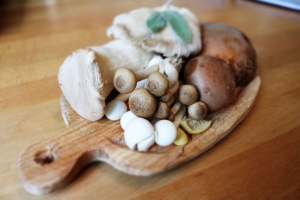
The story of Valon Bahtiri (32) from Hagen reads like a boy's book. From Maasdijk in Westland, this young director runs Europe's largest exotic mushroom company. He came here as a political refugee and is now director of an internationally operating organization.
Please click here for the complete article, for our dutch readers
Source: Algemeen Dagblad
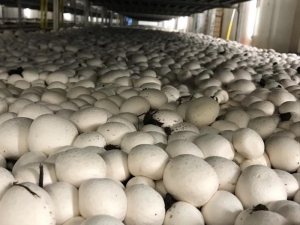
Double & Triple Flush, Fructification Mushroom technology
My name is Zlatko Vidmar. I have a Master’s Degree in Biology, with specializing in Micology. I have been working the mushroom industry for over forty years, mostly as a consultant. I have worked in Bosnia, Italy, China, Vietnam, Canada, USA, Australia and Algeria. While working in China, I paid special attention to technology after covering with casing material. The method I have been using for over thirty years, I called double and triple flush.
My methodology desires that the casing soil must be sufficiently moist for the first four to five days, after casing. Amount of water varies according to which peat moss is used, black or white, whether sugar beet live or sand is used and how many per cubic meters. What is the percentage mixture of white and black peat moss? The amount of water in those first couple of days is always different and varies from twelve to thirty or more liters.
The grower must make sure that casing soil is on the anaerobic edge after four or five days. The grower must pay attention to the growth of mycelium from the casing soil. I slowly blow air out of my mouth in the direction of the mycelium and if mycelium bends and returns to the starting position, I still wait with fresh air. When the mycelium becomes tired, solid and does not return to its original position, I put fresh air to maximum and increase the air flow.
Note that all the time, after casing, the fresh air is zero and ventilation is about forty percent. When I open fresh air, I add water at the same time; one liter per sq. meter. I lower air temperature and compost as soon as possible to nineteen (air) and twenty-one (compost). The next day, at the same time, I add another liter of water per sq. meter and continue with the flush. Forty-eight hours after the temperature of the compost is about twenty-one and the air temperature about nineteen, grower is able to see small formation of mushroom (pin heads). Many grower call this method of flushing hard flush, only without water.
Now comes what I call double flush.
I completely calm the room by turning off the ventilation and fresh air, actually I simply turn off the electricity. After that, I often tour the room and watch the growth of mushroom carefully. The duration of this part of the flush depends on what the grower wants. Large amount of mushrooms of lower quality (fresh + can) or less mushrooms with high quality (100% fresh).
Also, if the grower wants to stagger more, they can keep longer time without fresh air or ventilation.
I normally leave the room quiet for a minimum of six hours and maximum of ten hours. I think the best results are eight hours at better built farms with better equipment. After six, seven, eight, nine and ten hours, I re-add one liter of water per sq. meter and turn the room back on with full fresh air and ventilation up to ninety percent. The next day, I again repeat the same process of adding another liter of water per sq. meter and continue with the same ventilation and fresh air.
The following day, I set the ventilation to medium, close the fresh air to medium (CO2 around 2000ppm) and wait for the result of the process. If I have too many mushrooms the same size, I do triple flush repeating double flush, meaning I calm the room (no electricity) for eight hours. I, then, add one liter of water per sq. meter, ventilation (fan) 100x and fresh air the same, 100x.
I repeat watering the next day at the same time and the day after, set ventilation at 50x and fresh air at 40-50x (2000ppm CO2).
All the way until harvest, I ensure my mushrooms have all the above conditions for good growth and high quality.
I hope those that are reading this article, will try my technology and if you have any questions, feel free to contact me either via LinkedIn or via email below.
E-mail: This email address is being protected from spambots. You need JavaScript enabled to view it.
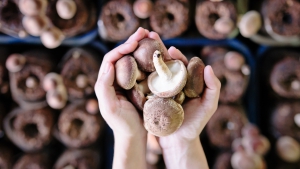

In a few words we wish to describe to you what e-nema does, for whom and why.
E-nema is commited to solve one of the fundamental issues in agriculture and development: the use of chemical pesticides.
E-nema GmbH is a successful company and market leader in the production of nematodes and represents the biological alternative to chemical insect control. Therefore e-nema combines cutting-edge technology and biological crop protection, always with the aim of making the world a better place.
In 1997 e-nema was founded in Schwentinental Germany by the three partners Prof. Dr. Ralf-Udo Ehlers, Dr. Arne Peters and Tillmann Frank to make a contribution to the compatibility of plant protection and nature conservation. With the product nemycel®, e-nema offers the biological alternative for controlling Sciarid in mushrooms. nemycel® contains the insect pathogenic nematode Steinernema feltiae. Nematodes are roundworms that are natural enemies of Sciarid fly larvae.
Nemycel is as easily applied as any chemical pesticide, but it is much more effective and environmentally friendly!
An international team works in the company's laboratories, on continually improving processes and products as well as developing new ideas and solutions for plant protection, aquaculture and in biocatalysis, the 'white' biotechnology. For further information or to contact e-nema, please visit their website. please visit their website.
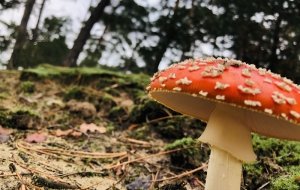
A wet start to October has brought mushrooms up all over the place. Other fungi have appeared with them. One has just killed one of my 30-year-old ornamental pear trees.
Please read the full article here.
Source: Financial Times Ltd, October 16 2020

Healthy Aging
Health and Nutrition
Micronutrients and Bioactive Compounds in Mushrooms A Recipe for Healthy Aging?
Mushrooms have been used both as food and as medicine in many cultures, and their popularity as both is growing in the United States. We have shown that they are inherently, or can easily be made to be, excellent dietary sources of 4 important bioactive compounds that are all known to decease in humans as they age.
Download the report here!
Source: Mushrooms Canada
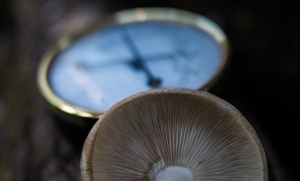
Climate control
A good climate control is of course vital for every mushroom grower even more if you want to stand out with the quality of the mushrooms. One of the most asked question I get as consultant is: How can we get better quality and how can we keep the quality of the mushrooms good until the end of the flush? Now, of course the quality at the end of the flushes will always be less than at the start, no illusions there. But improvements are always possible and most of that you can get from an ideal climate.
Before we had more advanced climate installations with more options, we always controlled the rooms on Air temperature, Relative humidity and CO2. However, with the new systems coming on the market there is a lot more to learn than we think and controlling rooms, especially in harvest stage, on moisture deficit, inlet moisture control and even measuring systems for evaporation are used.
To understand the difference between all the systems you need to know exactly what the Mollier Diagram stands for and if you manage to run the system well you will see advantages, especially in quality of the mushrooms. The Mollier Diagram is crucial in mushroom growing and climate computers make the changes in the room based on that Diagram with the Absolute humidity (AH) as the biggest factor. Let’s me explain a little bit more about of those controls, the moisture deficit.
As we are changing air temperatures in the flushes you will see in the Mollier Diagram that that will create differences in evaporation as we change the temperature but leave the RH the same, with other words, we change the AH. By controlling on moisture deficit we will maintain a constant evaporation, what will benefit the quality of the mushrooms, no matter what the temperature differences are. The computer will calculate the right RH for the current air temperature, to keep the same evaporation in the growing room.
Moisture deficit is the difference between the current absolute humidity in the room and the maximum possible absolute humidity at the same air temperature. Once this value is constant the evaporation capacity of the air is also constant.
To use this in a practical situation of course first of all you need a climate control computer that supports the moisture deficit system and change it from RH to moisture deficit control, in the computer that will be named as Absolut humidity control. Ideally this is linked with humidity control of the inlet air to get the best benefit. The mushrooms will have a constant evaporation and that will benefit the quality as changes in evaporation will disturb their growth. The mushrooms will get less water stems and go softer in a later stage what would give an extra picking days benefiting the yield as well as quality.
I recommend to change the computer 1 day before you start harvesting the flush from RH control to moisture deficit control. When you changed the control, set the AH in the computer so that the RH is at the same level as you normally run it in the flush. So if you normally run the flush on 17.5 degrees and 89% RH, keep the air temperature the same and set the AH so that he calculates the 89% RH as set point. Keep 0.2 difference between minimum and maximum AH. From that moment forward you let the computer calculate the right RH and change the air temperatures as you normally do, until the end of the flush. After the flush put the system back to RH control.
The only way to find out is try other controls to improve quality. Many option are out there and based on results on other farms worth trying. If you start and are seeing any improvement? Learn more and keep doing trials, good luck.
Erik de Groot
This email address is being protected from spambots. You need JavaScript enabled to view it.
And now for something completely different
The corona crisis makes traveling for a consultant difficult, if not impossible. That is why the question asked by Marco Deckers came just in time.
Henk, we are looking at picking on a different angle on our farm. GTL Europe is building my new farm with the tilting shelf system and we are creating a sparring team to start this up.
Now, that’s what I call a challenge.
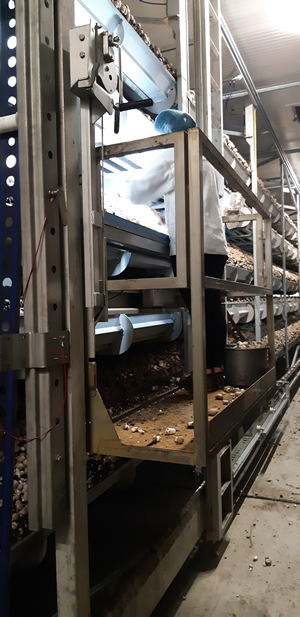 The system is so completely different that picking has to be re-designed.
The pickers are not standing sideways to the shelf but they are facing it and they have to learn to pick with two hands at the same time.
At the same moment we have to get them on a level where they can work in a high tech environment where they have to keep an eye on moving belts, tilting shelves and moving trollies. And yes, they also have to learn how to pick mushrooms at a good speed.
The first thing we did was to create a good team of new pickers and new supervisors. Because also in supervising the job is different. It is very simple to control quality and size of mushrooms because every mushroom you see coming out of the room on the conveyor belt has just been picked. So corrections on size or quality can be made immediately. You do not have to wait for the first trays of mushrooms to come out of the room. So supervising is easier. The biggest change for the supervisor in this case is more in the logistic and technical areas.
For the pickers the change is bigger.
Picking with two hands sounds nice but everyone is either right- or left handed. Only few people are double handed in their natural movement. This means that every picker has a preference to pick most mushrooms with one hand and a few in the other hand.
But this was actually easier to learn than expected. One thing that helps is the picking position. The height can per perfect so the picker does not have to bend the lower back or overstretch arms. It was simply a trick the had to learn. A mind set to position the arms that way as if it is one movement. The one thing they had to learn was to pick within eyesight and keep the arms together.
All together it is surprising to see that most of the pickers like the system a lot. Picking is fast and at the end of the day nobody is complaining about neck or shoulder problems. The usual complaints of a picker after a long day of picking. It has to be said though that the picker has to be told to put the platform at the right position. Pickers all over the world are a bit stubborn and if it is nearly right, for them it is okay. But it may not be the perfect position.
Looking back now we can draw a few conclusions.
It is better to start with pickers who have no experience in picking.
The supervisor is the main person in the team. Even more than in a traditional system. There is more technique involved and the supervisor needs to see possible problems fast and solve them
People have no problems with the environment full of moving parts. Even the opposite, they like it because it makes the work easier.
Training is essential. That is why at the moment we are writing a manual for that system on that particular farm. And again, in the training the supervisor (picking manager) is the key person.
And as a consultant you have to keep an open mind about the system and the way of picking. From the start till now you can say we started with system 2.0. Now we are already operating on system 5.0. It is evolving and growing in an exciting way. That is the benefit of having a good sparring team with the farm managemant, building company, picking staff and consultant.
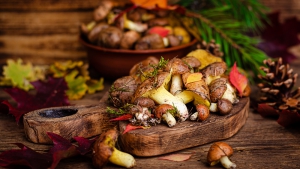
So Much Fungi
It shouldn’t be a surprise that humble mushrooms, fungi that feed on decaying matter, are such a popular ingredient throughout many of the world’s cuisines. After all, mold and yeast, two basic fungi, are responsible for turning milk into blue cheese, wheat into bread and, of course, grape juice into wine. Mushrooms can have a similar transformative effect on food, lending a deep savory character to all sorts of dishes. This intangible quality is often called “meaty,” but mushrooms have several distinct flavor components that make them a natural partner for wine.
Earthy
Few foods are as earthy as mushrooms, which often taste like the soil in which they grow. If this quality appeals to you, pick a wine that will tease it out, rather than overwhelm it. Red Burgundy from the Côte de Nuits is a great earthy expression of Pinot Noir with mushroom-like undertones.
Peppery
Many mushrooms, especially when raw, have a subtle peppery, throat-tickling quality akin to that of radishes. Tannins can accentuate this sensation in an unpleasant way, so try a rich white wine to smooth it out. As it ages, Rioja Blanco develops nutty, caramelized aromas and an almost creamy texture that match beautifully with mushrooms.
Read the full article here.
Source: Wine Enthusiast, by Nils Bernstein







