 Mushroom Matter
sharing mushroom news with care
Mushroom Matter
sharing mushroom news with care
Menubar









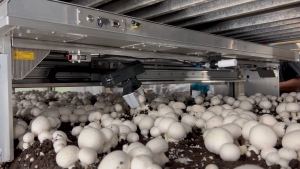
Just a week before our conversation, Stefan Glibetic attended the North American Mushroom Conference. While automation, robotics and data analytics were among the topics discussed, the dominant themes were familiar ones: labour shortages, declining mushroom consumption, pressure on margins, and the ongoing search for sustainable solutions that can help secure the future of the industry. For Stefan, these conversations felt very familiar. More than a decade ago, those same challenges were the reason Mycionics was founded.
A problem worth solving
Back in 2013, mushroom grower Murray Good approached the University of Western Ontario with what Stefan describes as a plea rather than a question. Labour was becoming increasingly difficult to find and retain, margins were shrinking, farms were struggling, and the long-term sustainability of the industry was at risk.
At the time, Stefan was studying robotics engineering. The challenge immediately caught his attention.
Many people viewed mushroom harvesting as too difficult to automate. Mushrooms are delicate, they grow in constantly changing environments, and any solution would need to meet strict food safety requirements while remaining affordable and practical for growers. Traditional automation simply did not fit the realities of mushroom farming. Rather than accepting that conclusion, Stefan wanted to understand why.
"The infrastructure already looked partially automated," he explained. "There were lifts, rails, conveyors and climate-controlled rooms. The question was whether modern robotics could take the next step."
Together with fellow researchers, university professors and Murray Good, he started exploring what would eventually become Mycionics.
From university project to commercial venture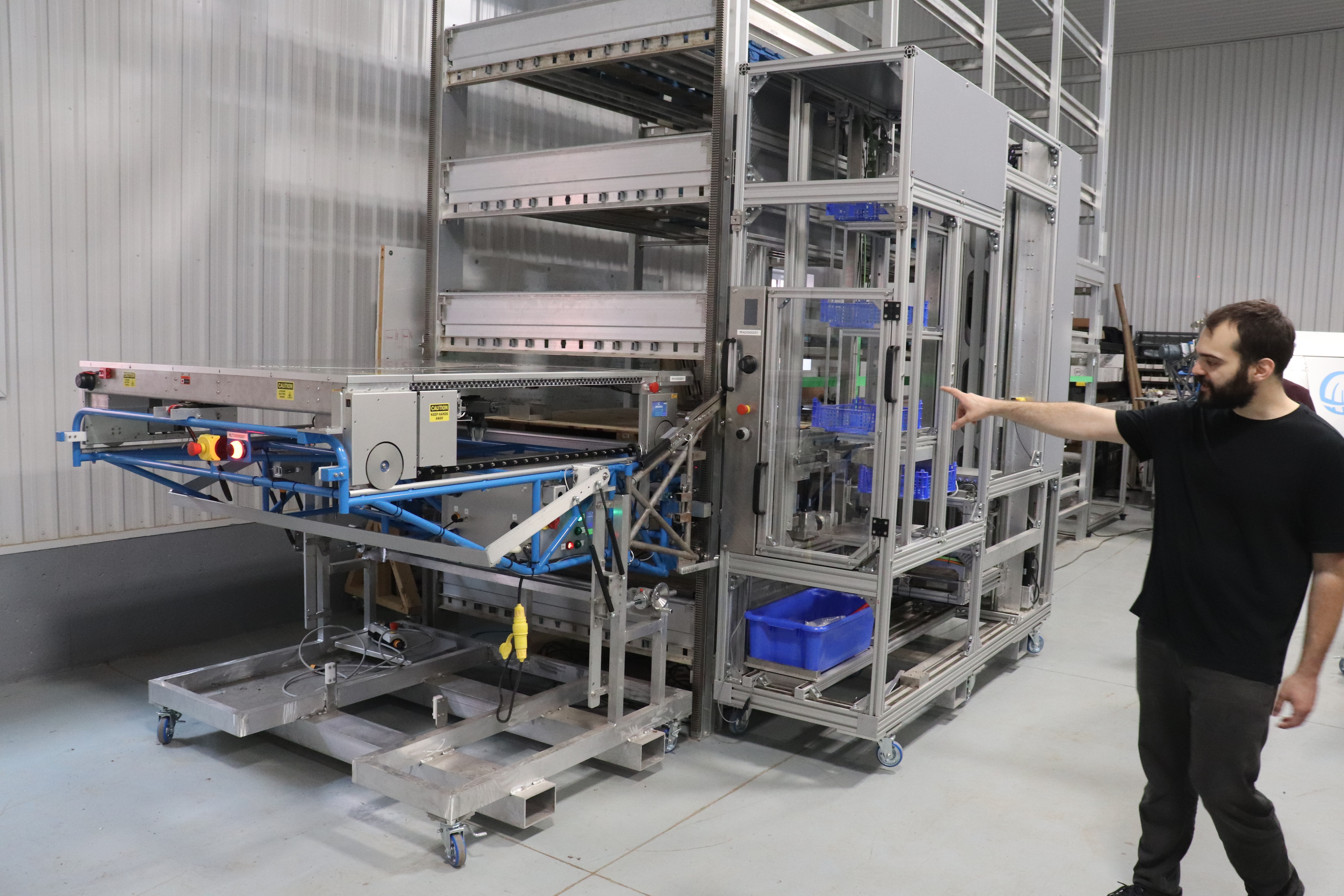
The first years were spent experimenting, testing and learning.
During his master's project, Stefan and another student developed an early robotic harvesting prototype capable of scanning mushroom beds, identifying mushrooms and picking them. It was slow and primitive by today's standards, but it demonstrated something important: robotic harvesting was possible.
Government-funded research grants helped finance the early work, while the mushroom farm supplied crates of mushrooms for testing different grippers, vision systems and harvesting methods under real conditions.
By 2014, Mycionics was officially formed. As interest and momentum grew, additional investment from Doug Wagner allowed the company to move beyond academic research and begin building a commercial business.
The team relocated to Murray's farm, hired engineers and began industrializing the technology. What followed was more than a decade of continuous iteration.
Learning on the farm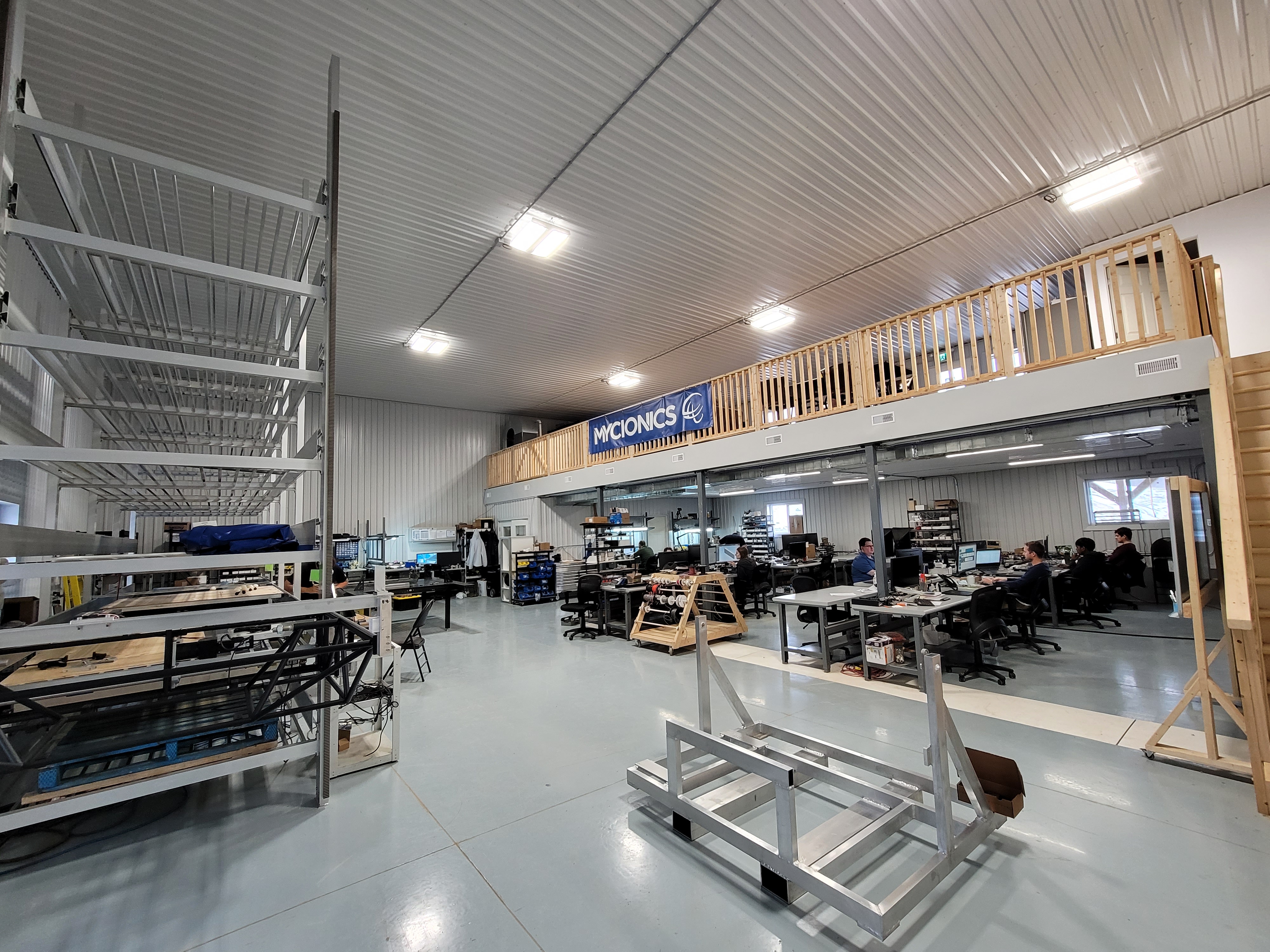
Being located directly on a mushroom farm became one of Mycionics' greatest advantages. Instead of developing technology in isolation, the team could test solutions in real-world conditions every day. New prototypes were built, deployed, tested, modified and tested again.
Humidity caused problems.
Infrastructure caused problems.
Reliability caused problems.
Every challenge became another lesson.
Over time, the company developed more than thirty generations of improvements across its harvesting, lifting and packing systems.
Perhaps no story captures those years better than the agreement Stefan made with the farm's head grower. If the robot failed to harvest the crop, the Mycionics team would finish the job themselves.
And it happened. Often.
Whenever the machines fell short, Stefan and his colleagues climbed onto the harvesting trolleys and picked mushrooms through the night. It was demanding work, but it taught them something invaluable. They learned firsthand what growers expect from technology, what reliability truly means, and how difficult it is to operate successfully in a commercial mushroom farm.
As Stefan puts it, a mushroom farm does not need impressive technology. It needs technology that works.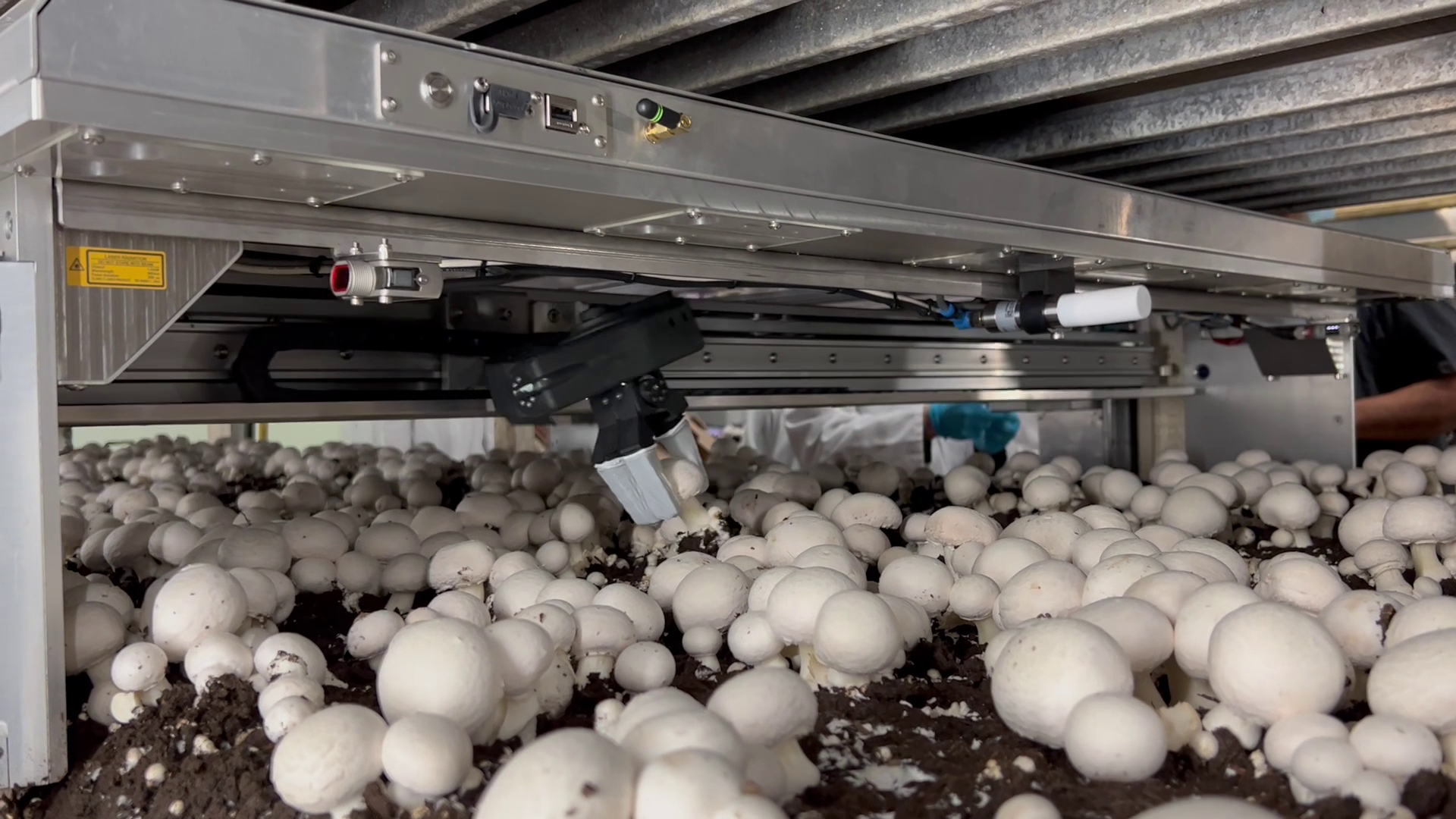
Proving it could be done
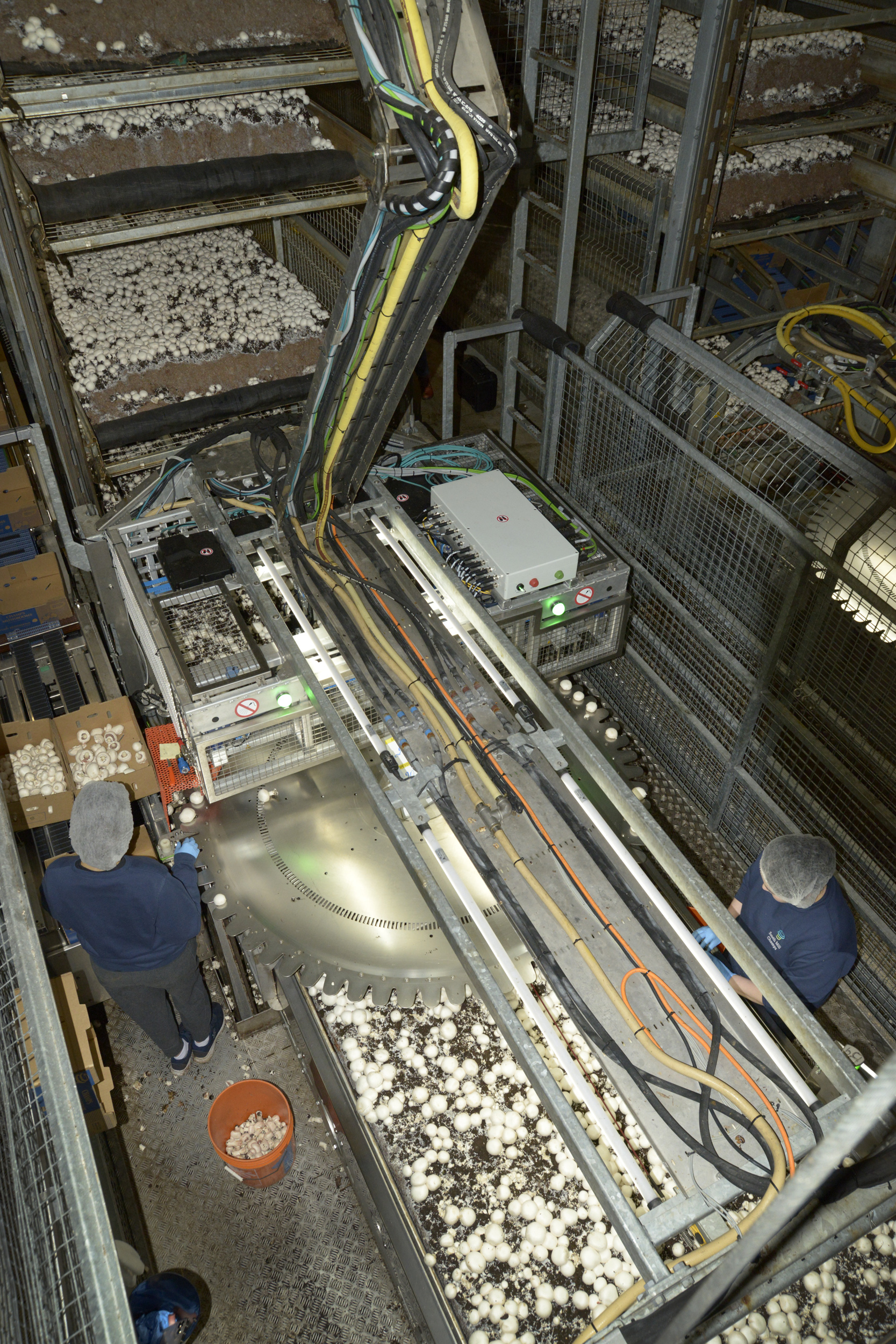
By 2022, Mycionics had achieved something many considered impossible. The company had developed a complete robotic harvesting system capable of picking, cutting, packing and stacking mushrooms within traditional Dutch aluminium shelving systems. Multiple robots worked together, sharing data and coordinating tasks throughout the growing rooms.
Technically, the challenge had been solved. The robots could harvest mushrooms around the clock, produce excellent quality, and successfully complete the full harvesting process.
Commercially, however, the breakthrough had not yet arrived.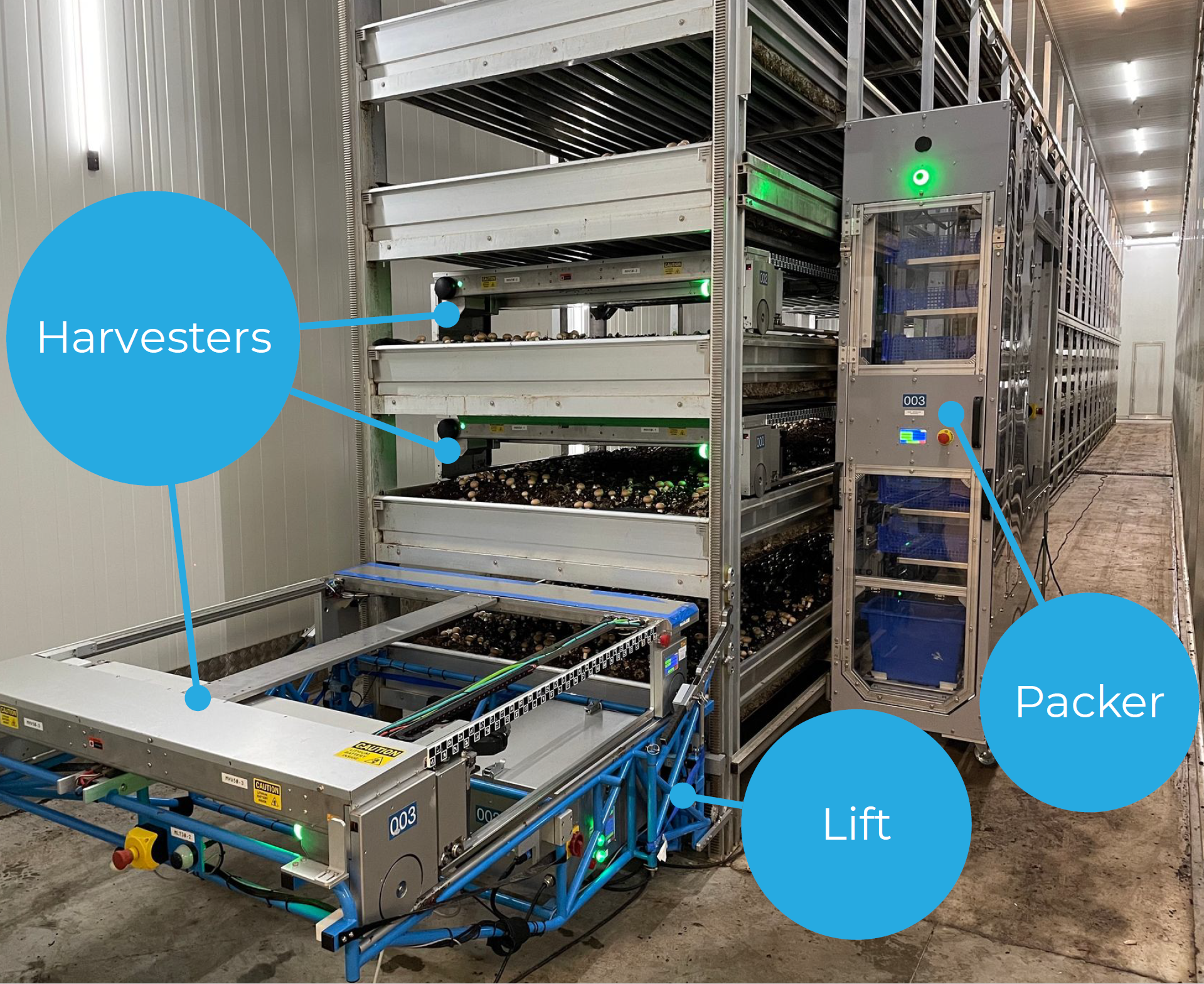
Despite the technological achievement, the systems were still not fast enough and not cost-effective enough to provide the breakthrough growers truly needed. 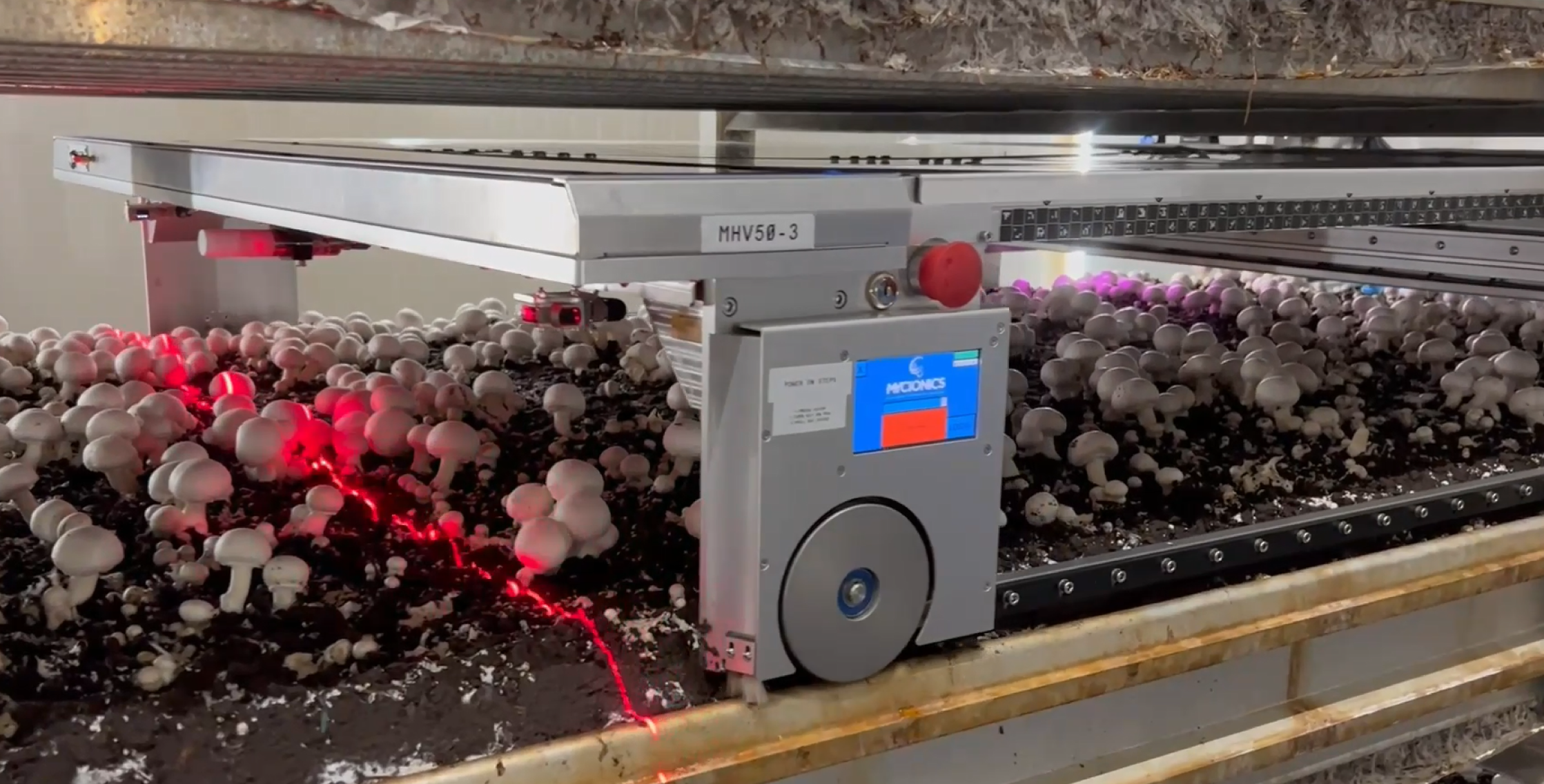
Many companies would have commercialised the system anyway. Mycionics chose a different path.
Starting over to move forward
In 2023, Mycionics chose to rethink its approach. Rather than pushing a solution to market simply because it worked, Stefan and his team stepped back and asked a different question:
What does the industry actually need? The answer was not full automation. The answer was smarter automation.
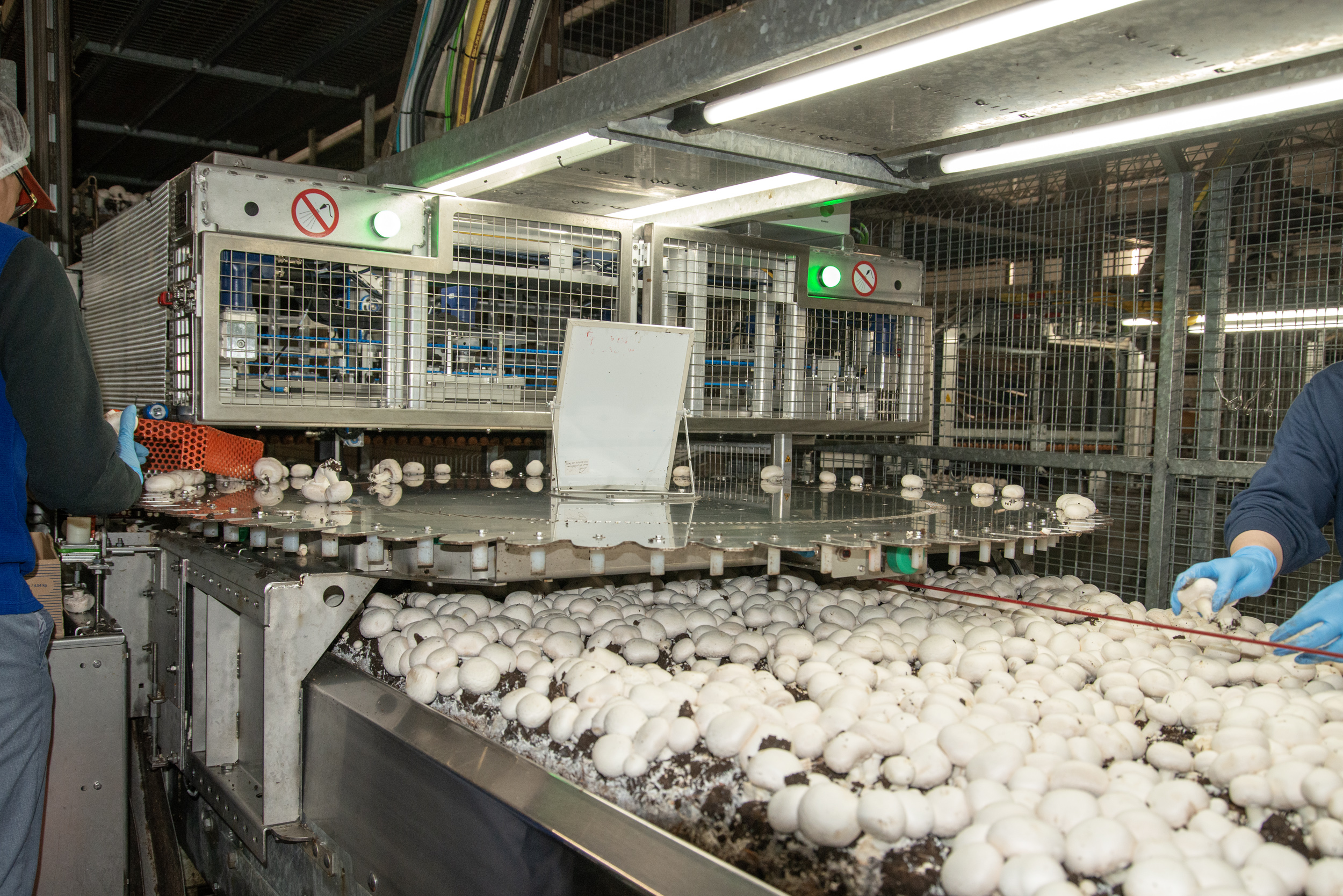
The team redesigned its technology around a hybrid model that combines the strengths of both people and machines. Robots focus on repetitive tasks such as harvesting, packing and handling. People focus on higher-value activities such as thinning, pruning, quality control and crop management. This approach dramatically improved the economics while maintaining flexibility for growers.
The company also modularized its entire technology platform, ensuring systems could be maintained by farm staff rather than requiring specialist technicians. In an industry where crops cannot wait, that distinction matters.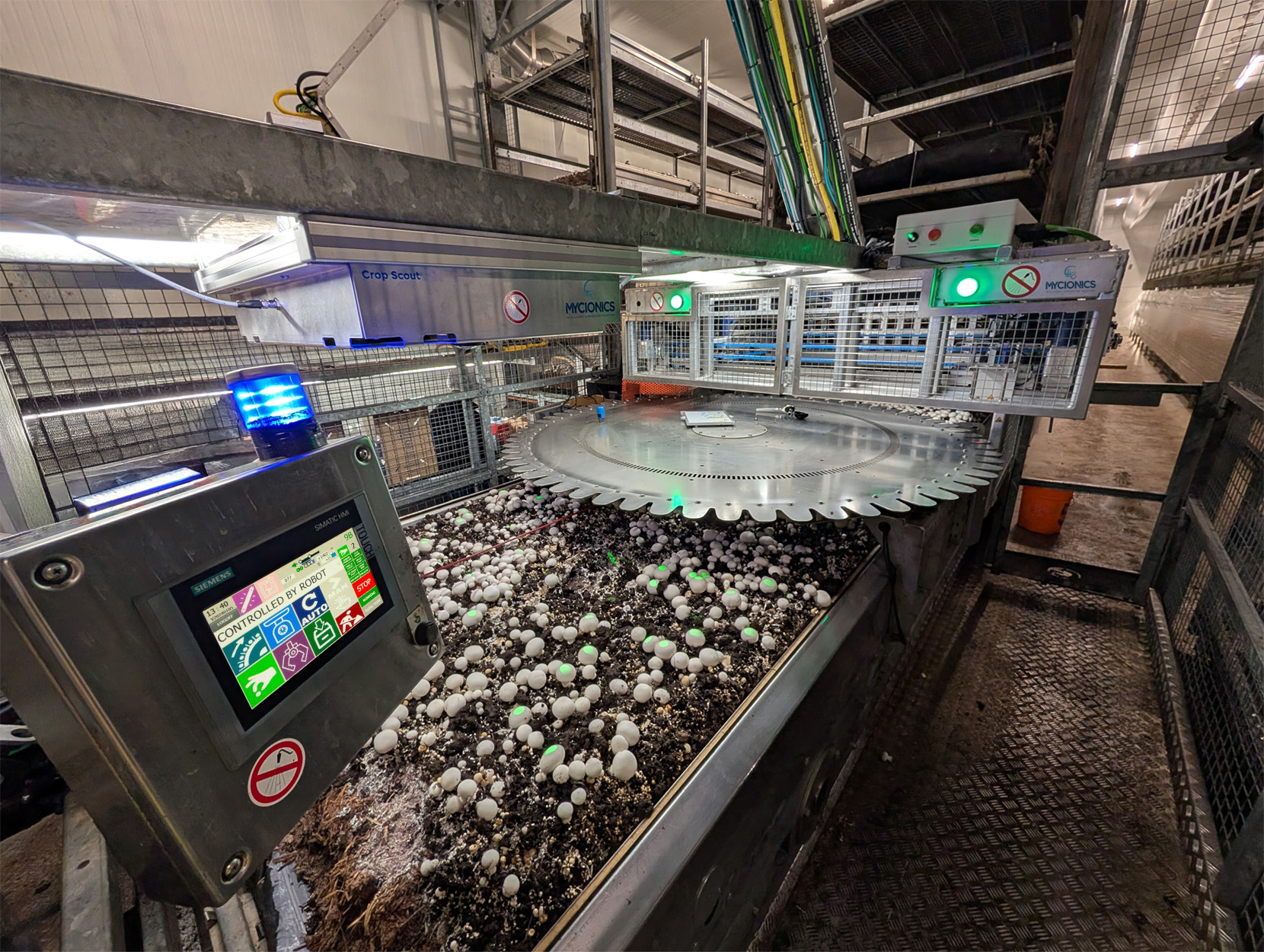
Today, Mycionics adapts its solutions to different farming infrastructures, including drawer systems and traditional Dutch shelving, each with different levels of automation depending on what makes the most practical and economic sense.
From robotics to crop intelligence
As the technology evolved, another opportunity emerged. Data.
The robots weren't just harvesting mushrooms anymore. They were collecting information.
Every mushroom scanned by a robot generates data. Every harvest creates new insights. Every growing cycle reveals patterns.
Mycionics realised that its vision systems could provide value long before a mushroom was ever picked.
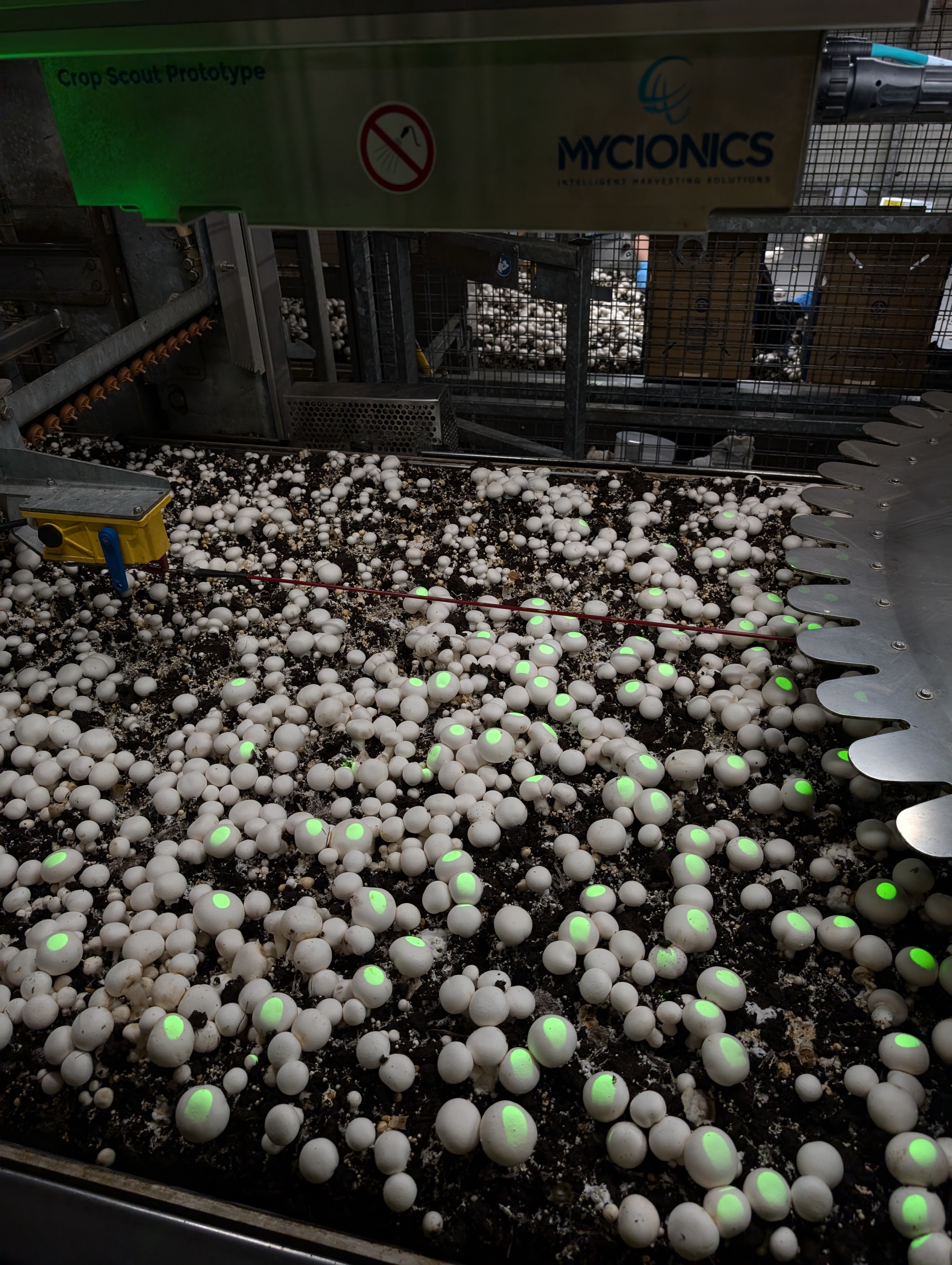
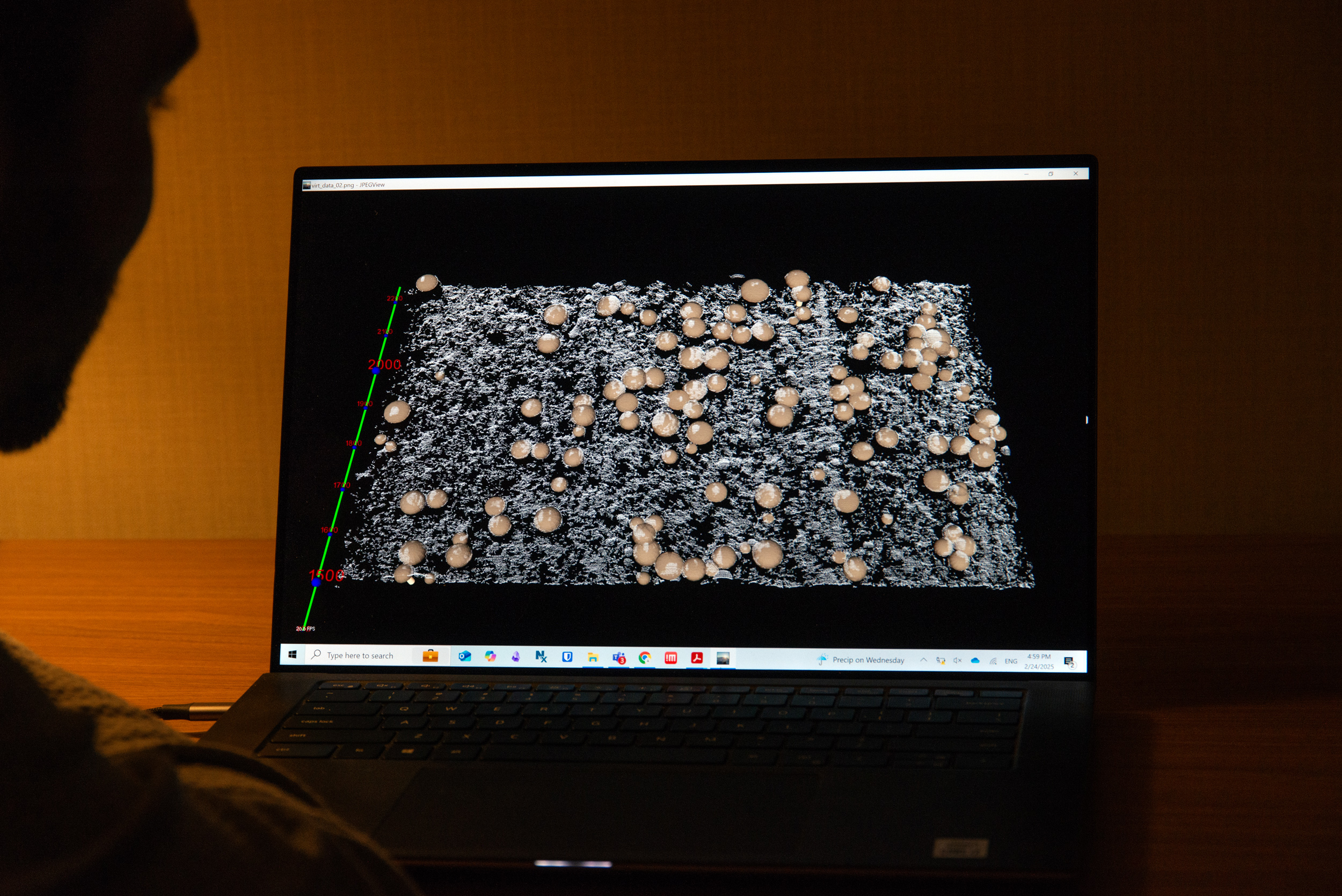
This led to the development of Crop Scout and pointing systems that help growers track mushroom growth, optimize harvesting decisions and improve yields. The results have been significant.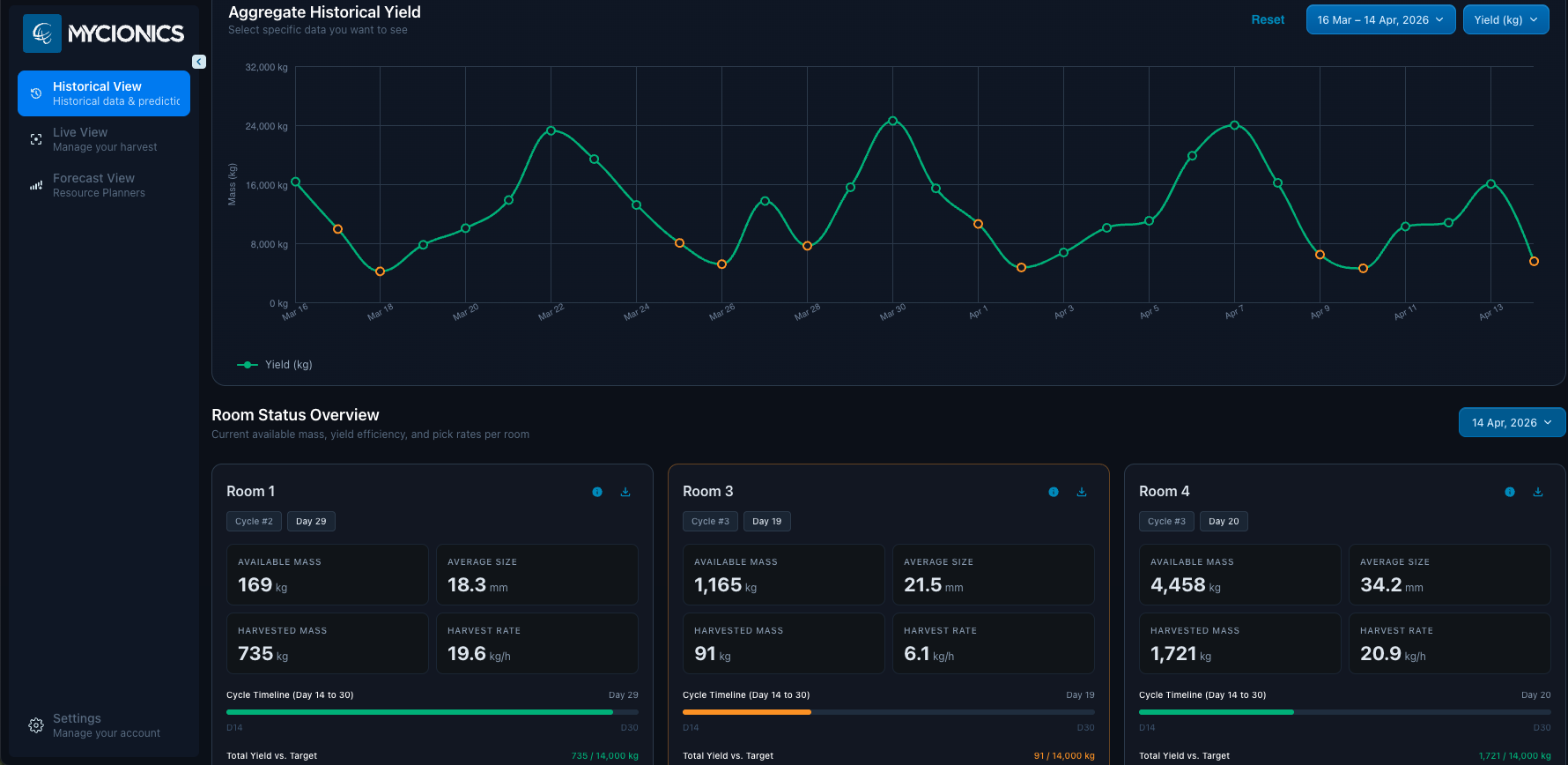
At South Mill Champs in Canada, the value of the technology became so apparent that the company purchased eighteen scanning and pointing units for deployment across its farm. According to Mycionics, the system is currently delivering an average yield improvement of 6.3 percent, representing approximately 23,000 additional pounds of mushrooms per unit annually. For growers, that is a meaningful impact.
Check out Mycionics Case study here.
Collaboration over competition
Throughout our conversation, one theme surfaced repeatedly: collaboration. Mycionics actively works with industry partners such as Limbraco and Christiaens to ensure technologies integrate seamlessly into existing farm infrastructures. Rather than trying to solve every challenge independently, the company believes the best solutions emerge through cooperation. That philosophy even extends to competitors.
Stefan speaks positively about other Canadian automation companies and believes that broader adoption of robotics across the industry benefits everyone involved. "If more farms successfully adopt automation, that's good for the industry."
It is a perspective that reflects the company's long-term mindset. Success is not measured by individual machines, but by the overall progress of the mushroom sector.
Looking ahead
Today, Mycionics continues to expand across Canada, the United States, Europe, Australia and New Zealand, while also attracting interest from South and Central America. The company is currently growing its team, adding new talent and preparing for the next phase of deployment.
Yet Stefan sees the future extending far beyond harvesting automation.
His vision is a connected mushroom industry where data flows between growers, compost suppliers, spawn producers, genetics companies, logistics providers and climate-control systems. A future where better information leads to better decisions, higher yields and a more sustainable industry.
The possibility of applying Mycionics technology to other crops may come one day. But for now, the focus remains firmly on mushrooms.
The company may be known for its robotics, but Stefan’s passion has never been about robots alone. It has always been about solving a problem worth solving.
That problem first took shape more than ten years ago, when Stefan, then a mushroom grower himself, began asking whether robotics could help secure the future of mushroom farming.
The answer wasn't built overnight.
It took thousands of tests, countless iterations and the willingness to start over when the first solution wasn't good enough. That mindset still defines Mycionics today.
Because building better robots has never been the company's ultimate goal. Building a stronger, more sustainable mushroom industry is.

What’s moving the mushroom industry right now?
What’s moving the mushroom industry right now?
The mushroom sector continues to evolve at pace. Automation, labour availability and cost efficiency remain dominant themes, while growers balance innovation with reliability on the farm floor.
Below are a few developments worth reading!
Hybrid harvesting, semi-automation and technology that works with biology
The mushroom industry continues to evolve as growers balance biological realities with technological progress. While automation and robotics have advanced significantly in recent years, the sector is increasingly recognising that the most effective innovations are those that support, rather than replace the biological and operational dynamics of mushroom cultivation.
Three developments are particularly shaping how growers approach technology today: hybrid harvesting, the return on investment of semi-automation, and systems that adapt to biological variability.
Together, these trends illustrate a shift away from the idea of fully autonomous farms towards a more pragmatic model of technological integration.
Hybrid harvesting as a structural solution
For many growers, hybrid harvesting is becoming a structural solution rather than a temporary transition phase.
Fully autonomous harvesting remains difficult in mushroom production because crops rarely grow in perfectly predictable patterns. Flushes vary in density, size and timing, making it challenging for robotic systems to match the adaptability and decision-making of experienced pickers.
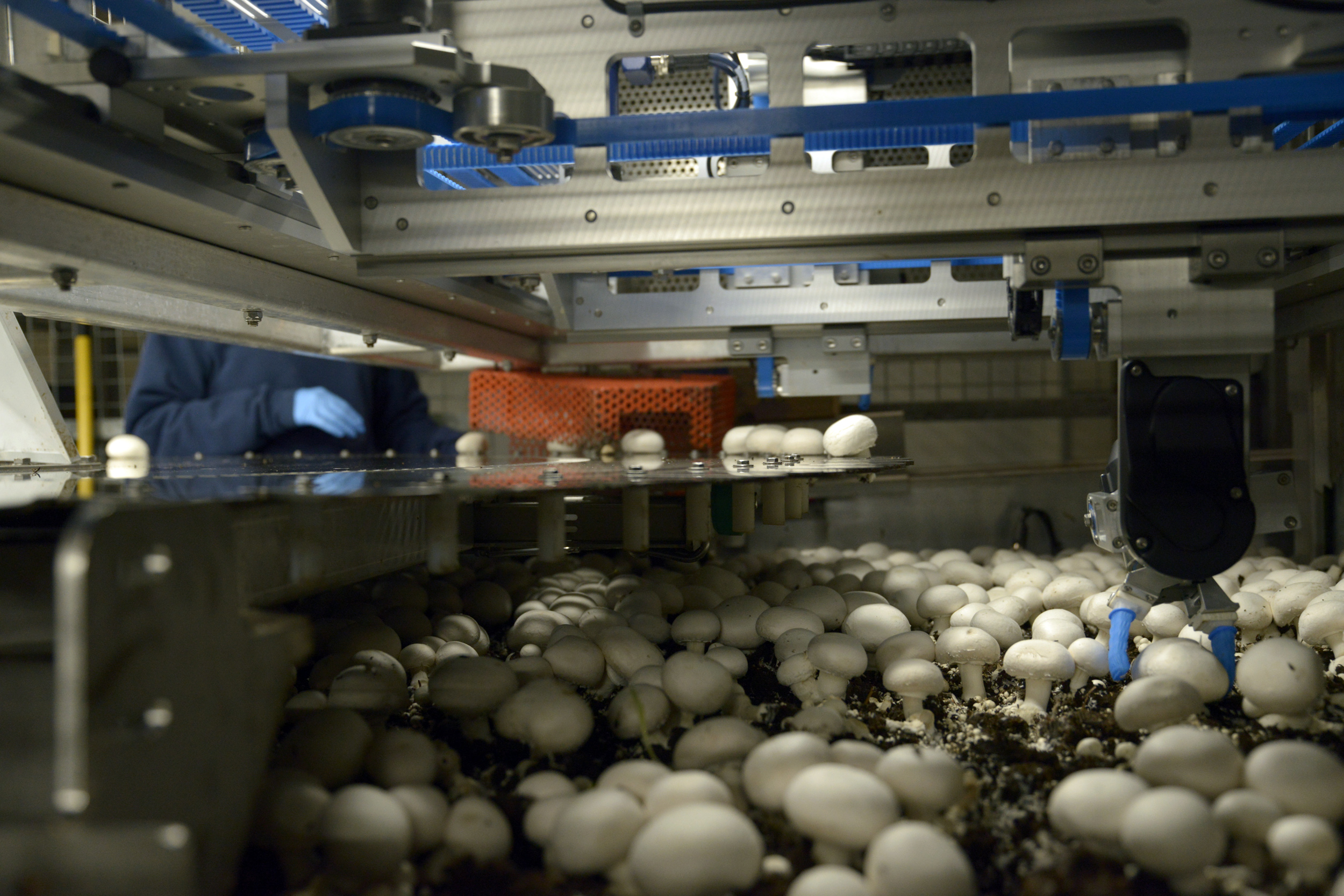
Hybrid harvesting systems combine automated harvesting equipment with human labour, allowing technology to handle repetitive tasks while workers focus on quality selection and precision picking.
This approach allows growers to stabilise harvesting capacity during peak production periods while maintaining the flexibility needed to respond to crop variability. Instead of replacing labour entirely, automation becomes a tool that supports workers and improves overall operational resilience.
The ROI of Semi-Automation
While the concept of fully automated farms often attracts attention, many growers are finding that the most impactful investments come from semi-automation.
Technologies that support specific steps in the production process, such as climate control optimisation, grading systems, conveyor handling or partial harvesting automation, can deliver clear operational improvements without requiring massive infrastructure changes.
Semi-automation allows farms to modernise gradually while keeping systems manageable and adaptable. The focus is increasingly on measurable outcomes such as:
-
improved labour efficiency
-
reduced physical strain for workers
-
more consistent product quality
-
better production planning
As a result, growers are evaluating technology not only based on innovation potential but on practical return on investment. Systems that deliver stable performance and integrate well with existing workflows are often prioritised over more complex fully autonomous solutions.
Technology that adapts to biological variability
One of the defining characteristics of mushroom cultivation is biological variability. Even under controlled environmental conditions, each flush can develop differently in terms of growth speed, density and size distribution.
Historically, many technological solutions attempted to impose uniformity on this process. However, the industry is increasingly recognising that successful technology must adapt to biology rather than forcing biological systems into rigid production models.
New developments in sensor technology, climate control algorithms and data monitoring are helping growers better understand and respond to the dynamics of their crops.
By analysing environmental data and production patterns, growers can make more informed decisions about climate adjustments, harvesting timing and production planning. This approach allows farms to optimise yield quality and consistency while respecting the natural behaviour of the crop.
In this context, technology becomes a support system that enhances biological production rather than trying to override it.
A pragmatic path forward
The current direction of technological development in the mushroom industry reflects a broader shift towards practical optimisation.
Instead of focusing solely on breakthrough automation, many growers are prioritising systems that improve reliability, efficiency and operational flexibility. Hybrid harvesting, semi-automation and adaptive technologies all represent pragmatic steps that help farms manage labour challenges while maintaining high production standards.
As the industry continues to integrate digital tools, robotics and data-driven growing systems, the most successful innovations will likely be those that respect the complex biological nature of mushroom cultivation.
Looking ahead
In the next edition of Mushroom Matter Industry Insights, we will explore several additional developments shaping the sector, including:
-
data-driven mushroom farming and the role of sensors and AI
-
energy efficiency in mushroom cultivation
-
the next generation of harvesting robotics
These topics continue the conversation about how technology can support a resilient and sustainable future for mushroom production.
We’ll continue to follow these developments closely and share insights that matter to growers, farm managers and technology partners.
Published by Mushroom Matter: connecting the global mushroom community through insight, innovation, and inspiration
The benefits of hybrid harvesting - Mycionics
Why collaborative robotics make sense in mushroom production
What happens when humans and robots harvest side by side? Not in theory, but in the real, high-pressure reality of mushroom farms, with variable growth, peak flushes, labour shortages and razor-thin margins.
Hybrid harvesting, also known as collaborative robotics, is gaining ground precisely because it doesn’t pretend farming is predictable. Instead of forcing full automation before the technology or the farm is ready, it offers a practical middle path, robots and people working together, each doing what they do best.
For many growers, that balance is exactly what makes automation finally workable.
Why hybrid harvesting matters right now
There is a growing consensus in the industry that fully autonomous harvesting is not yet a universal answer. Mushrooms don’t grow the same way twice. Flushes vary, beds behave differently, and peak moments can overwhelm even the fastest machines.
At the same time, labour pressure continues to rise. Growers are looking for solutions that reduce dependency on manual labour, without taking on the risk of an all-or-nothing automation leap.
Hybrid harvesting answers that tension. It allows farms to automate step by step, task by task, proving value along the way, while keeping humans involved where flexibility, judgment and backup capacity are essential. In short, it lowers risk, increases resilience, and makes automation adaptable to real farming conditions.
What hybrid harvesting actually means
Mycionics defines hybrid harvesting as giving growers control over how much of the harvesting process is done by robotics and how much by people, and being able to adjust that balance when conditions change.
In practice, many robotic systems can handle around 70 to 80 percent of the physical picking work. But the remaining portion often determines profitability, especially during peak flushes, selective picking moments and quality-critical decisions.
Hybrid systems are designed to absorb those fluctuations. When robots reach their maximum capacity, human pickers can seamlessly augment the process. When labour is scarce, automation takes the lead. The system does not fail when reality deviates from the average.
Designing for reality, not perfection
A key reason Mycionics chose a hybrid path is simple. In complex environments, trying to be cheaper, faster and better at the same time usually leads to compromises elsewhere.
Mushroom harvesting involves thousands of micro-decisions per shift. Where to go on the bed. Which mushrooms are at the right stage. How to pick without damage. Where to place product. How to manage containers and flow.
Humans are strong in judgment and adaptation. Robots excel at consistency, precision and repetition. Hybrid harvesting assigns each role accordingly.
Mycionics’ proprietary vision, decision support and crop-intelligence system identifies mushroom size, predicts growth and determines optimal picking moments. These decisions can then be executed either by robotic arms or by human pickers, removing cognitive load from people while preserving flexibility. The result is faster picking, better timing and more consistent quality.
From scanning to packing, a modular approach
Hybrid harvesting does not start or end with picking.
Pre-harvest scanning maps pinned beds, tracks growth over time and predicts when and where harvesting should begin and how to adjust environmental factors to boost yield. Crop Scout guidance points human pickers to the mushrooms that should be harvested first, eliminating guesswork and increasing efficiency.
Robotic harvesting units mounted on drawers or lorries can handle large volumes, placing mushrooms onto belts, conveyance systems or directly into containers. During short, intense flush periods, humans can work alongside the robots to temporarily increase capacity during separation.
After picking, packing makes up about 50% of the labor cost in harvest. Robotic packing systems automate one of the most labour-intensive stages, improving weight accuracy, reducing giveaway and maintaining best presentation quality – “cheaper faster better”!. Because all modules share the same vision and intelligence backbone, growers can scale gradually, investing when confidence and return on investment make sense.
Measurable impact on farms
Early results in side-by-side comparisons on neighboring beds show why this approach resonates. Where growers are using crop intelligence and guided picking see around 15 percent improvement in labour efficiency and 10 to 15 percent yield improvement through better harvest timing.
With robotic harvesting, up to 75 percent of picking labour can be automated using multi-arm systems, with human support during early separation days to set the bed for full automation. Robotic packing significantly reduces labour demand in a stage that often represents around half of total harvest labour costs.
Beyond the numbers, growers value something less tangible but equally important. Systems that keep working when conditions are not perfect and never tire.
The role of AI, and where humans still matter
Machine vision and AI improve with data. The more cycles a system runs, the more accurate it becomes at recognising patterns, detecting anomalies and recommending actions.
Robots do not get tired or inconsistent. Over time, they become highly precise. Humans, however, still outperform algorithms in contextual judgment, especially when something unexpected happens. Hybrid harvesting acknowledges that reality instead of fighting it.
By collecting data early and continuously, growers build the foundation for smarter automation over time, without betting the farm on day one.
Looking ahead, hybrid as the bridge forward
Over the next three to five years, hybrid harvesting is likely to become the dominant automation model in mushroom production. Not as a compromise, but as a transition strategy that works NOW.
As technology proves itself in the field, confidence grows and returns grow. As confidence and returns grow, automation deepens. The system remains flexible, modular and grounded in farm realities.
The guiding principle remains simple. It has to work.
Born out of mushroom farming itself, Mycionics continues to focus on solutions that deliver value immediately, scale responsibly and strengthen the industry as a whole. There is no winner-takes-all model here, only progress that works when everyone can keep up with the harvest.

https://mushroommatter.com/details/itemlist/tag/hybridharvesting#sigProIdd0a238aee6





