










Why collaborative robotics make sense in mushroom production
What happens when humans and robots harvest side by side? Not in theory, but in the real, high-pressure reality of mushroom farms, with variable growth, peak flushes, labour shortages and razor-thin margins.
Hybrid harvesting, also known as collaborative robotics, is gaining ground precisely because it doesn’t pretend farming is predictable. Instead of forcing full automation before the technology or the farm is ready, it offers a practical middle path, robots and people working together, each doing what they do best.
For many growers, that balance is exactly what makes automation finally workable.
Why hybrid harvesting matters right now
There is a growing consensus in the industry that fully autonomous harvesting is not yet a universal answer. Mushrooms don’t grow the same way twice. Flushes vary, beds behave differently, and peak moments can overwhelm even the fastest machines.
At the same time, labour pressure continues to rise. Growers are looking for solutions that reduce dependency on manual labour, without taking on the risk of an all-or-nothing automation leap.
Hybrid harvesting answers that tension. It allows farms to automate step by step, task by task, proving value along the way, while keeping humans involved where flexibility, judgment and backup capacity are essential. In short, it lowers risk, increases resilience, and makes automation adaptable to real farming conditions.
What hybrid harvesting actually means
Mycionics defines hybrid harvesting as giving growers control over how much of the harvesting process is done by robotics and how much by people, and being able to adjust that balance when conditions change.
In practice, many robotic systems can handle around 70 to 80 percent of the physical picking work. But the remaining portion often determines profitability, especially during peak flushes, selective picking moments and quality-critical decisions.
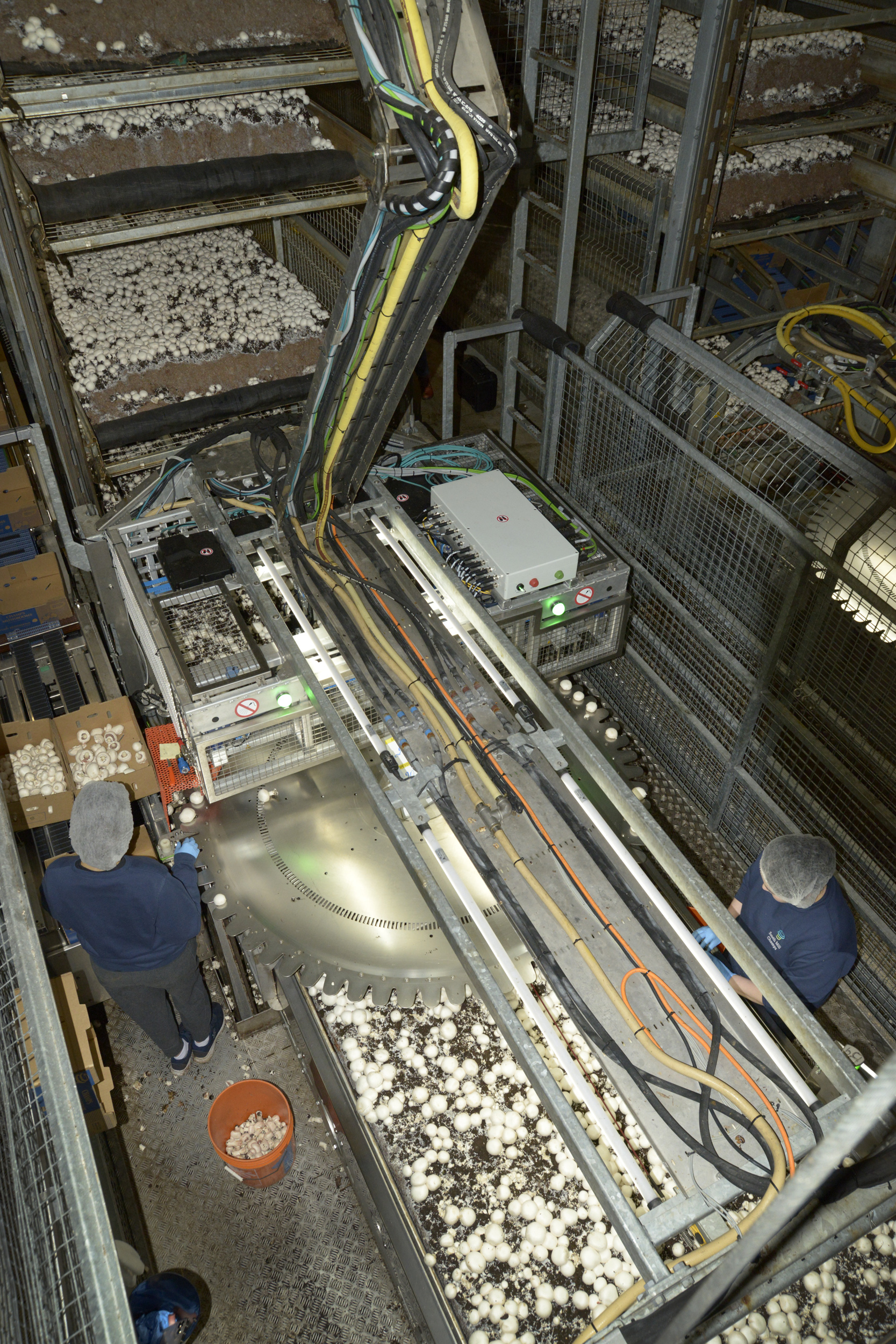
Hybrid systems are designed to absorb those fluctuations. When robots reach their maximum capacity, human pickers can seamlessly augment the process. When labour is scarce, automation takes the lead. The system does not fail when reality deviates from the average.
Designing for reality, not perfection
A key reason Mycionics chose a hybrid path is simple. In complex environments, trying to be cheaper, faster and better at the same time usually leads to compromises elsewhere.
Mushroom harvesting involves thousands of micro-decisions per shift. Where to go on the bed. Which mushrooms are at the right stage. How to pick without damage. Where to place product. How to manage containers and flow.
Humans are strong in judgment and adaptation. Robots excel at consistency, precision and repetition. Hybrid harvesting assigns each role accordingly.
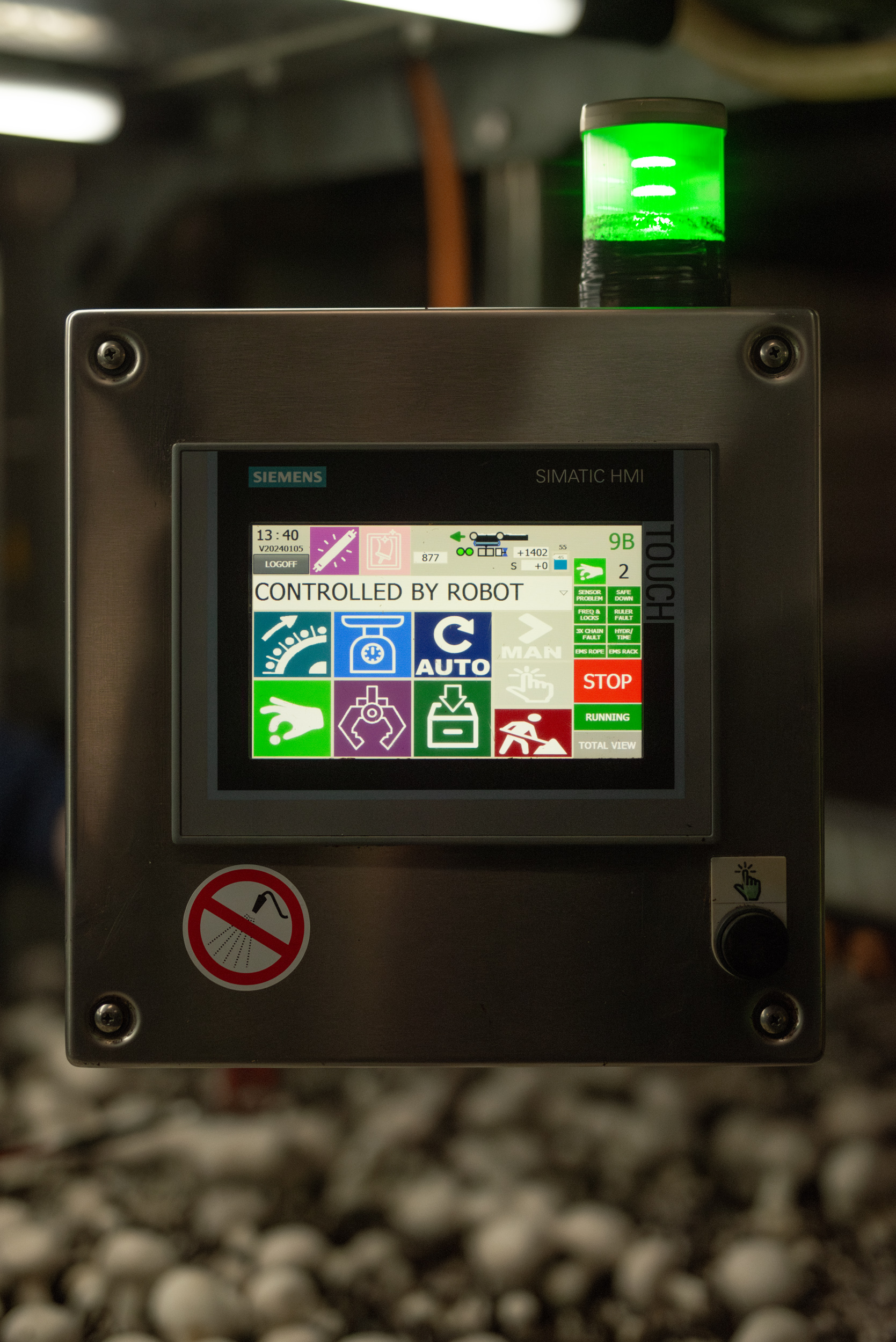
Mycionics’ proprietary vision, decision support and crop-intelligence system identifies mushroom size, predicts growth and determines optimal picking moments. These decisions can then be executed either by robotic arms or by human pickers, removing cognitive load from people while preserving flexibility. The result is faster picking, better timing and more consistent quality.
From scanning to packing, a modular approach
Hybrid harvesting does not start or end with picking.
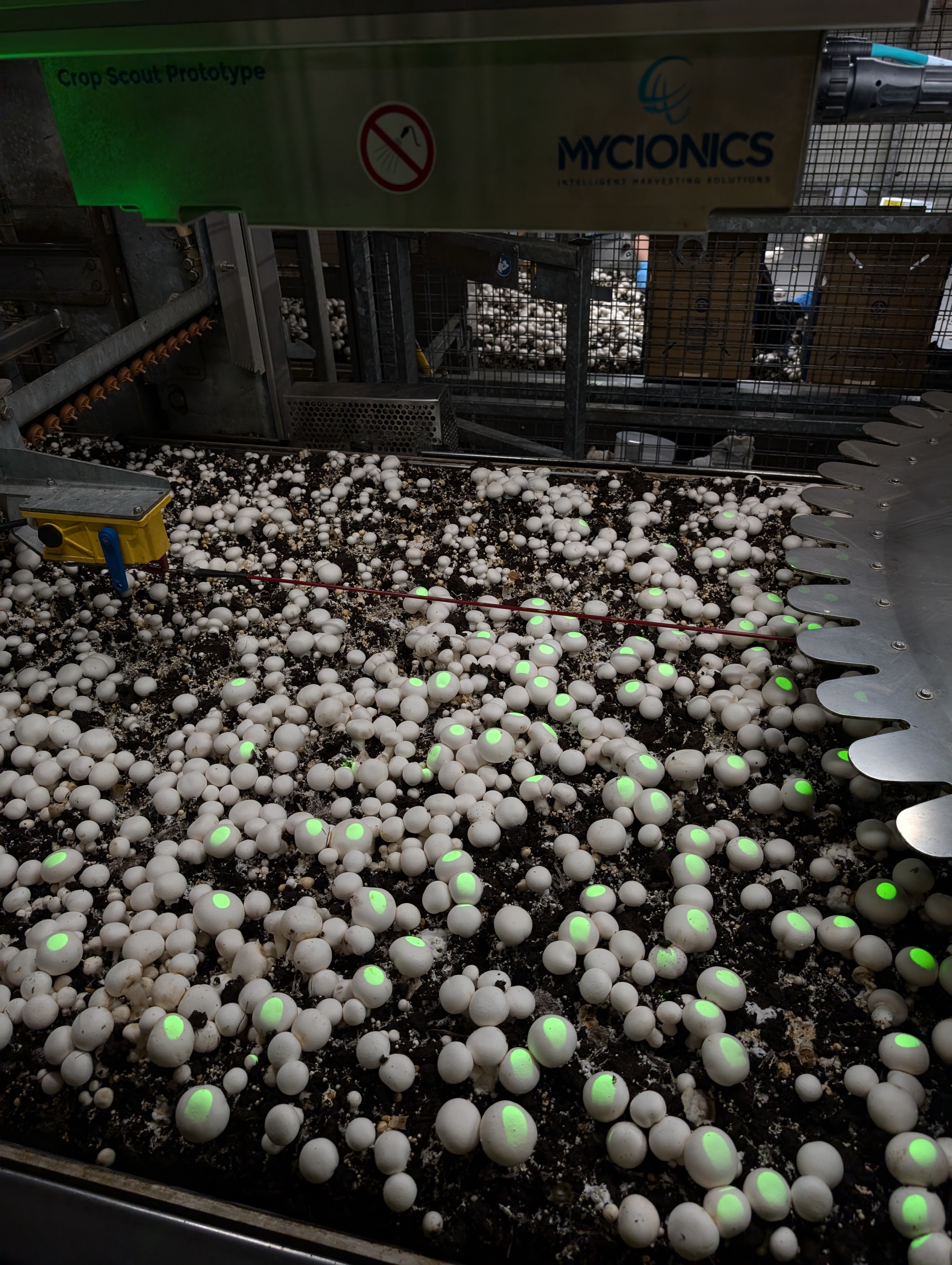
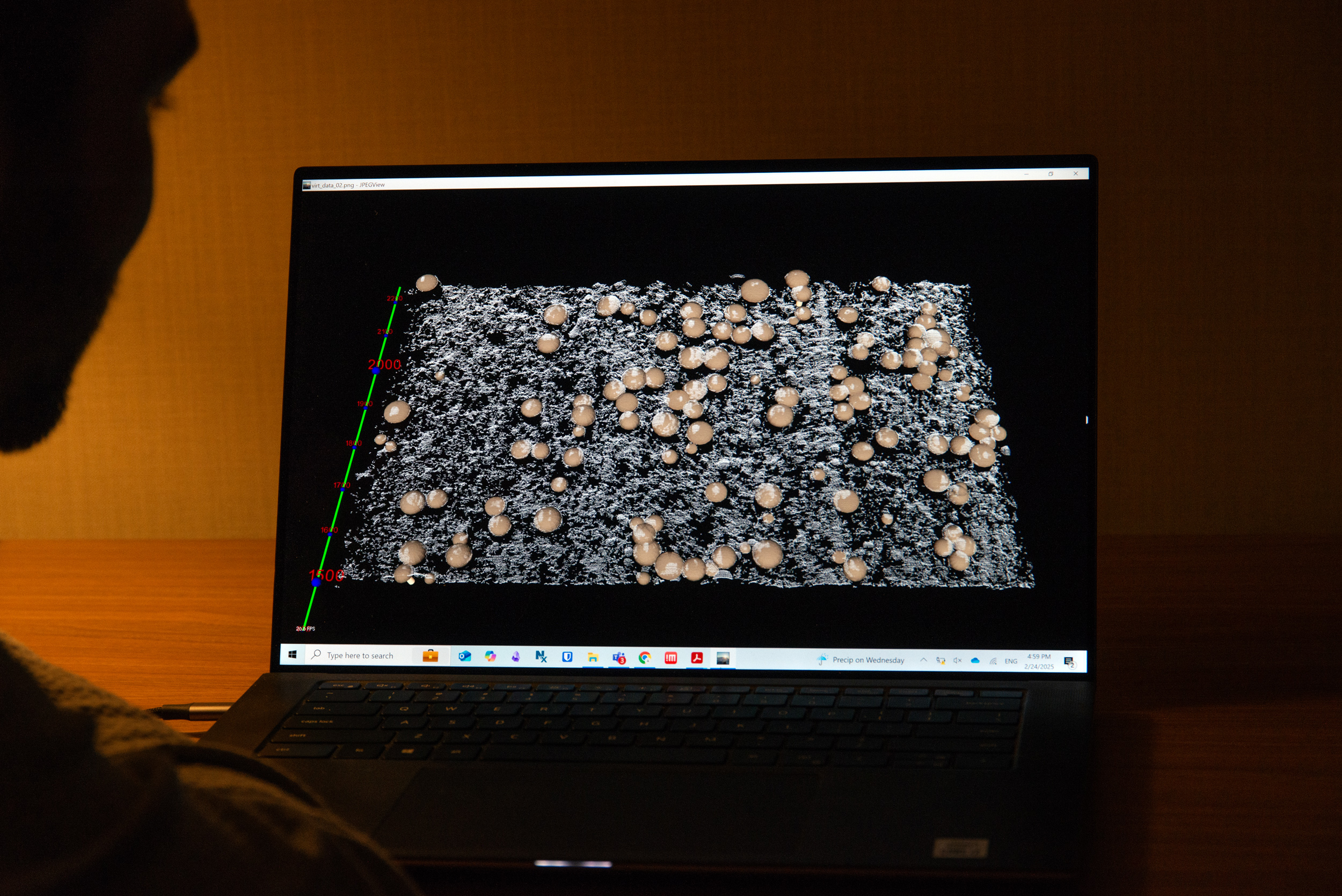
Pre-harvest scanning maps pinned beds, tracks growth over time and predicts when and where harvesting should begin and how to adjust environmental factors to boost yield. Crop Scout guidance points human pickers to the mushrooms that should be harvested first, eliminating guesswork and increasing efficiency.
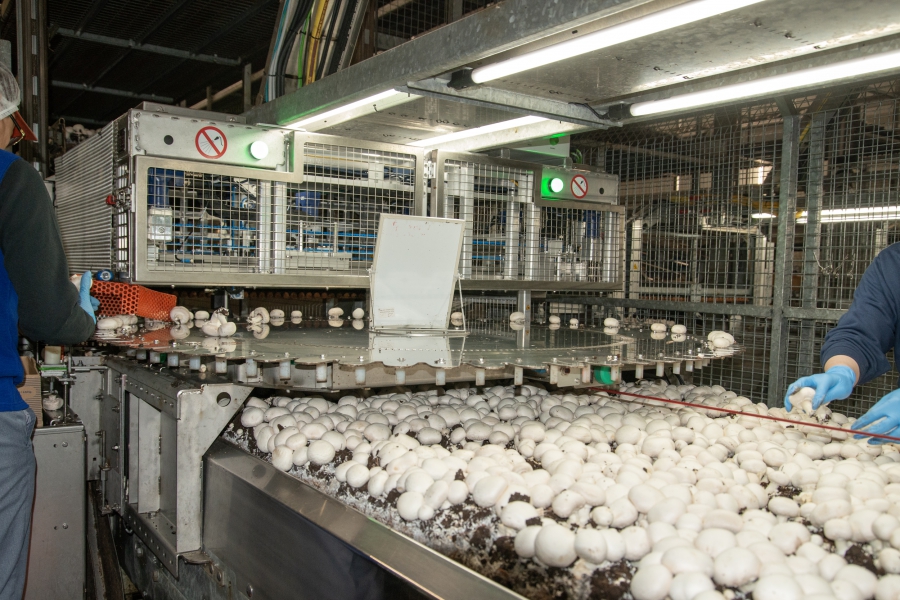
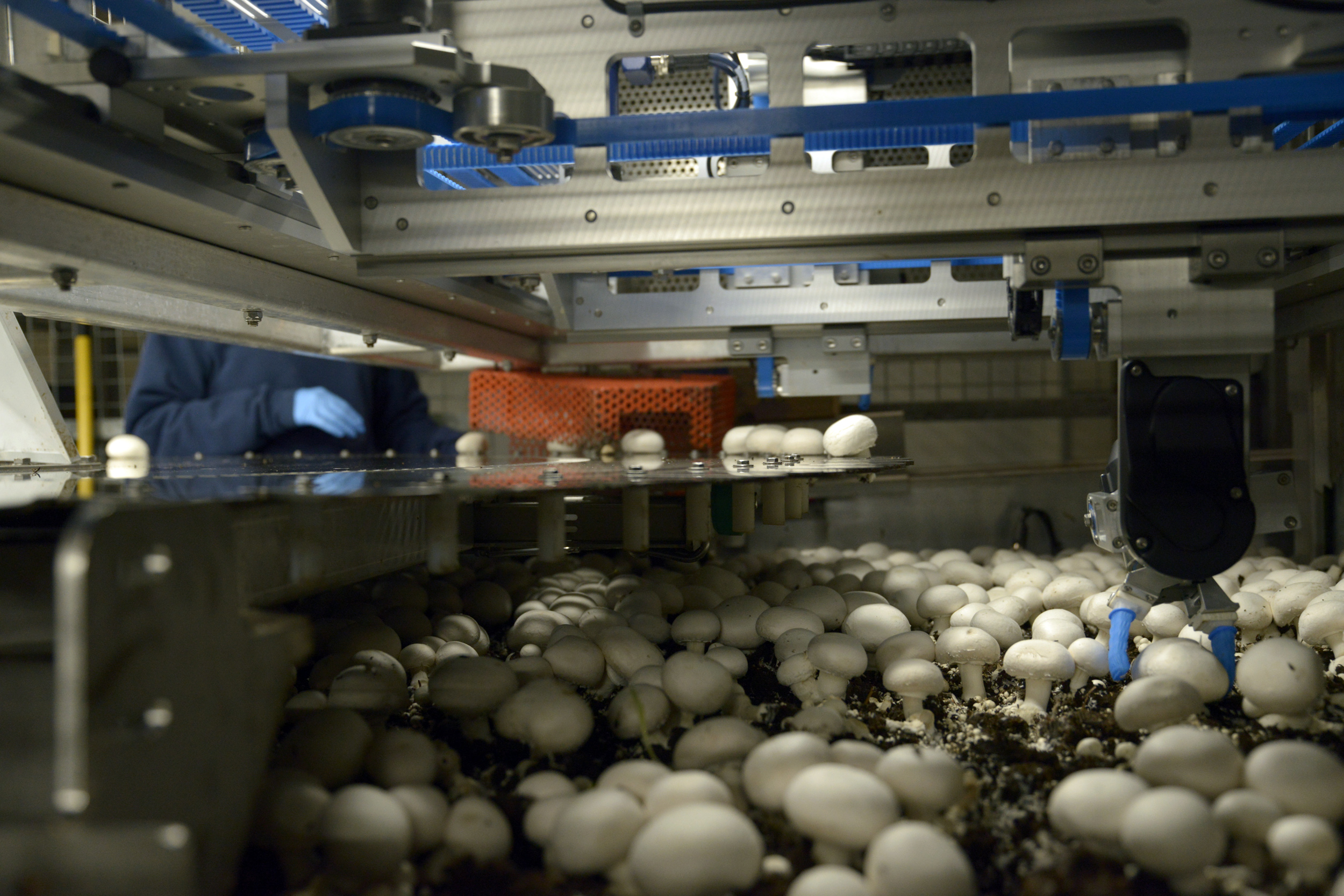
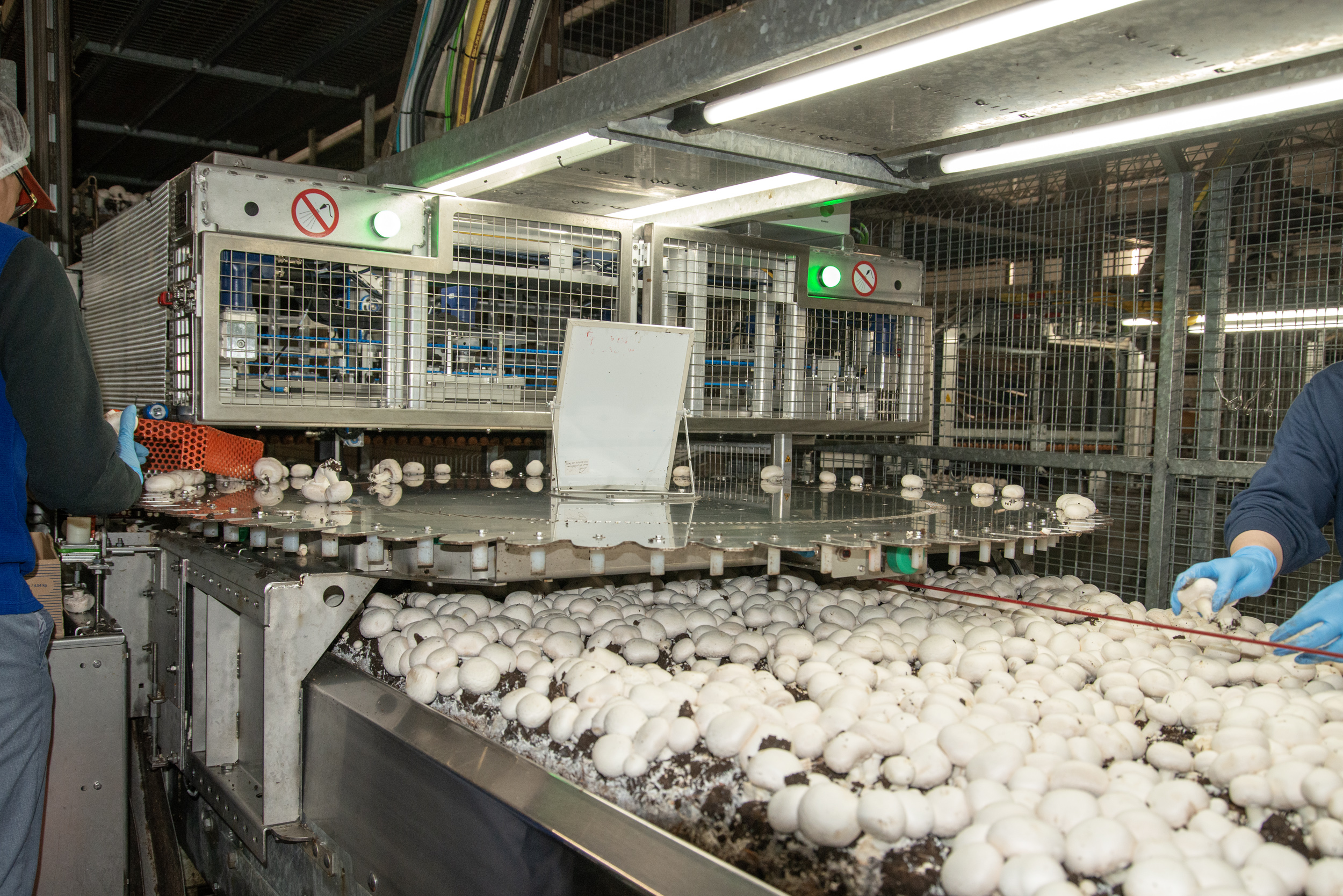
Robotic harvesting units mounted on drawers or lorries can handle large volumes, placing mushrooms onto belts, conveyance systems or directly into containers. During short, intense flush periods, humans can work alongside the robots to temporarily increase capacity during separation.
After picking, packing makes up about 50% of the labor cost in harvest. Robotic packing systems automate one of the most labour-intensive stages, improving weight accuracy, reducing giveaway and maintaining best presentation quality – “cheaper faster better”!. Because all modules share the same vision and intelligence backbone, growers can scale gradually, investing when confidence and return on investment make sense.
Measurable impact on farms
Early results in side-by-side comparisons on neighboring beds show why this approach resonates. Where growers are using crop intelligence and guided picking see around 15 percent improvement in labour efficiency and 10 to 15 percent yield improvement through better harvest timing.
With robotic harvesting, up to 75 percent of picking labour can be automated using multi-arm systems, with human support during early separation days to set the bed for full automation. Robotic packing significantly reduces labour demand in a stage that often represents around half of total harvest labour costs.
Beyond the numbers, growers value something less tangible but equally important. Systems that keep working when conditions are not perfect and never tire.
The role of AI, and where humans still matter
Machine vision and AI improve with data. The more cycles a system runs, the more accurate it becomes at recognising patterns, detecting anomalies and recommending actions.
Robots do not get tired or inconsistent. Over time, they become highly precise. Humans, however, still outperform algorithms in contextual judgment, especially when something unexpected happens. Hybrid harvesting acknowledges that reality instead of fighting it.
By collecting data early and continuously, growers build the foundation for smarter automation over time, without betting the farm on day one.
Looking ahead, hybrid as the bridge forward
Over the next three to five years, hybrid harvesting is likely to become the dominant automation model in mushroom production. Not as a compromise, but as a transition strategy that works NOW.
As technology proves itself in the field, confidence grows and returns grow. As confidence and returns grow, automation deepens. The system remains flexible, modular and grounded in farm realities.
The guiding principle remains simple. It has to work.
Born out of mushroom farming itself, Mycionics continues to focus on solutions that deliver value immediately, scale responsibly and strengthen the industry as a whole. There is no winner-takes-all model here, only progress that works when everyone can keep up with the harvest.

https://mushroommatter.com/advertisement/advertorials/item/1049-the-benefits-of-hybrid-harvesting#sigProIdd0a238aee6





