 Mushroom Matter
sharing mushroom news with care
Mushroom Matter
sharing mushroom news with care
Menubar






Just a week before our conversation, Stefan Glibetic attended the North American Mushroom Conference. While automation, robotics and data analytics were among the topics discussed, the dominant themes were familiar ones: labour shortages, declining mushroom consumption, pressure on margins, and the ongoing search for sustainable solutions that can help secure the future of the industry. For Stefan, these conversations felt very familiar. More than a decade ago, those same challenges were the reason Mycionics was founded.
A problem worth solving
Back in 2013, mushroom grower Murray Good approached the University of Western Ontario with what Stefan describes as a plea rather than a question. Labour was becoming increasingly difficult to find and retain, margins were shrinking, farms were struggling, and the long-term sustainability of the industry was at risk.
At the time, Stefan was studying robotics engineering. The challenge immediately caught his attention.
Many people viewed mushroom harvesting as too difficult to automate. Mushrooms are delicate, they grow in constantly changing environments, and any solution would need to meet strict food safety requirements while remaining affordable and practical for growers. Traditional automation simply did not fit the realities of mushroom farming. Rather than accepting that conclusion, Stefan wanted to understand why.
"The infrastructure already looked partially automated," he explained. "There were lifts, rails, conveyors and climate-controlled rooms. The question was whether modern robotics could take the next step."
Together with fellow researchers, university professors and Murray Good, he started exploring what would eventually become Mycionics.
From university project to commercial venture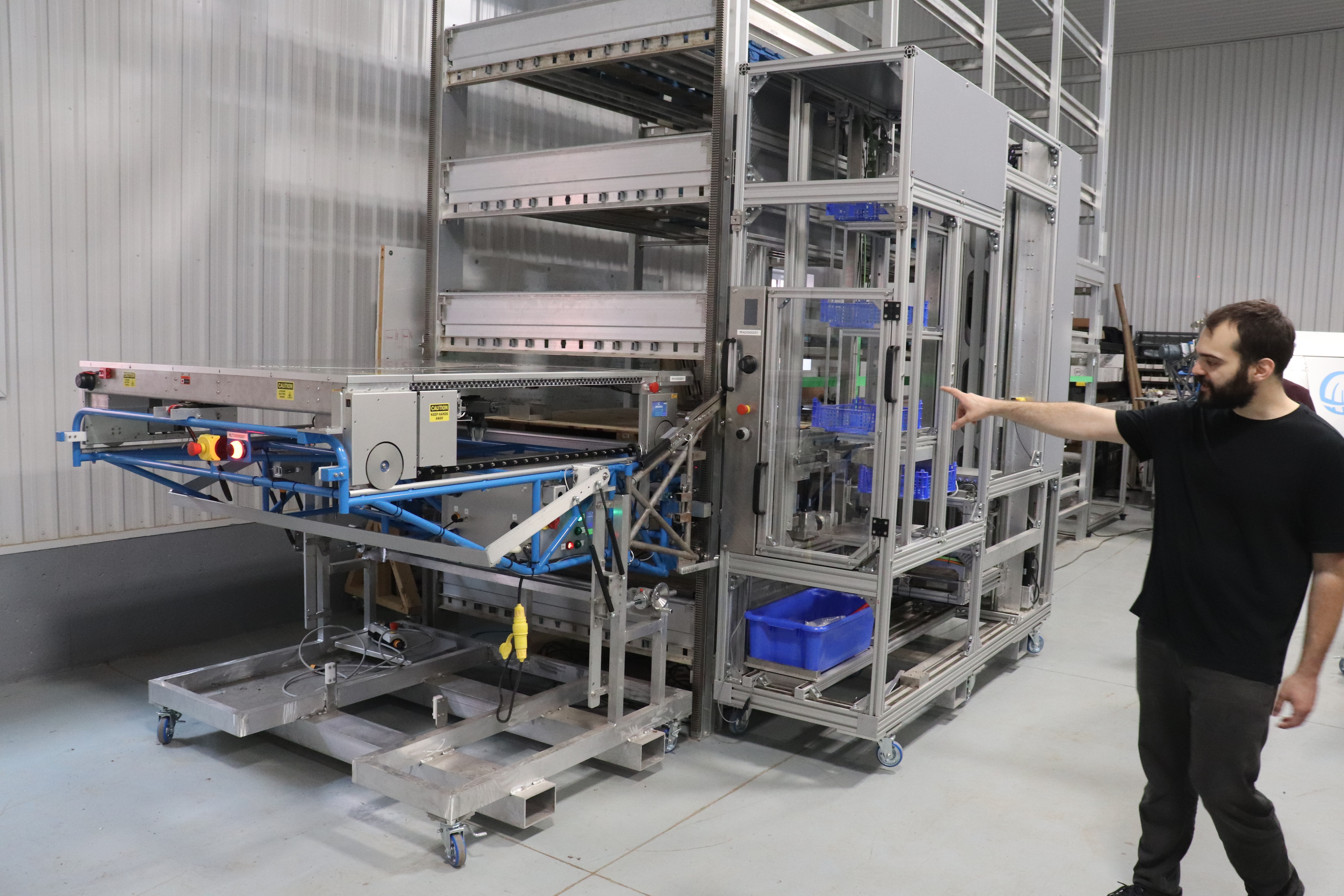
The first years were spent experimenting, testing and learning.
During his master's project, Stefan and another student developed an early robotic harvesting prototype capable of scanning mushroom beds, identifying mushrooms and picking them. It was slow and primitive by today's standards, but it demonstrated something important: robotic harvesting was possible.
Government-funded research grants helped finance the early work, while the mushroom farm supplied crates of mushrooms for testing different grippers, vision systems and harvesting methods under real conditions.
By 2014, Mycionics was officially formed. As interest and momentum grew, additional investment from Doug Wagner allowed the company to move beyond academic research and begin building a commercial business.
The team relocated to Murray's farm, hired engineers and began industrializing the technology. What followed was more than a decade of continuous iteration.
Learning on the farm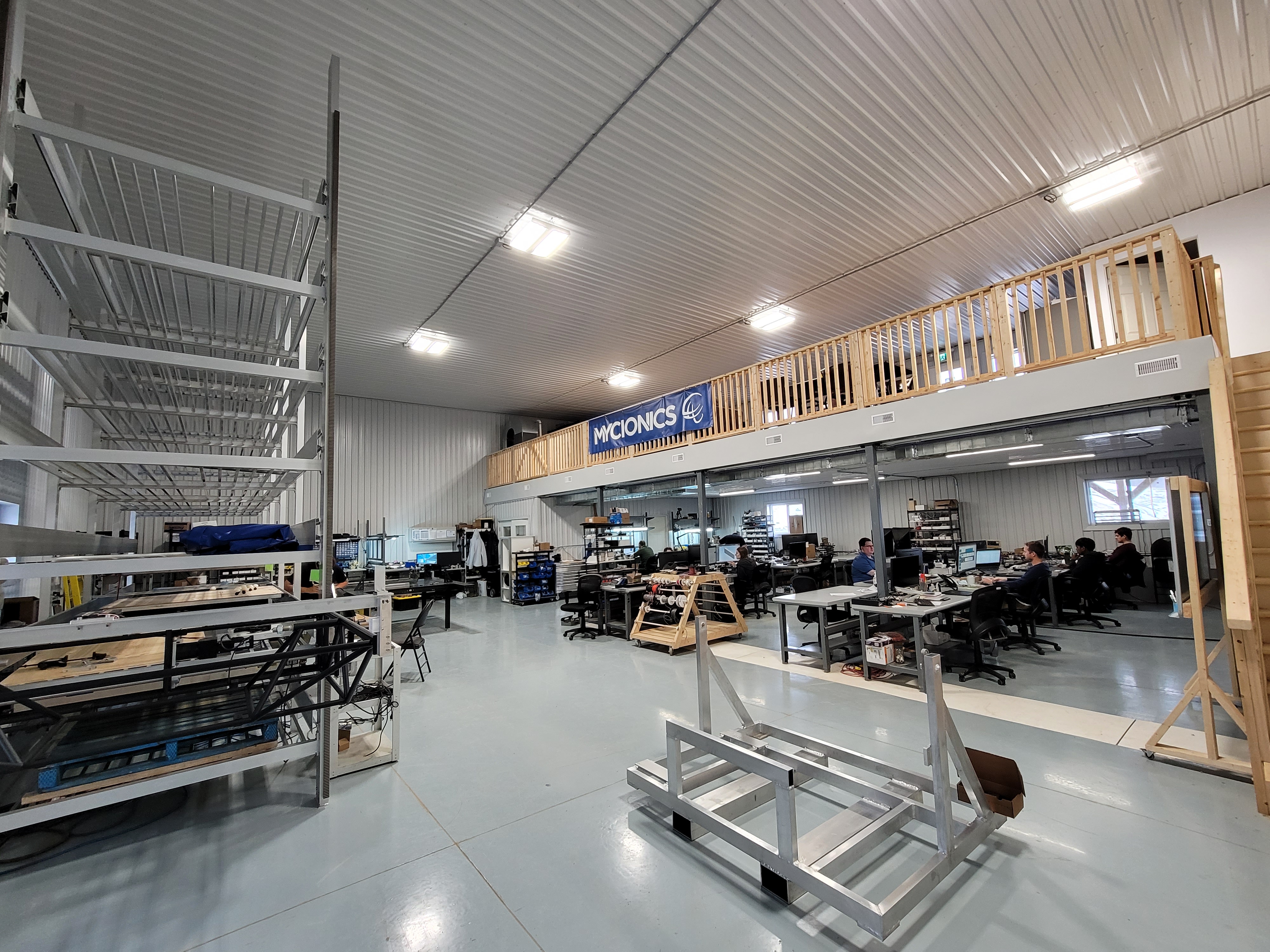
Being located directly on a mushroom farm became one of Mycionics' greatest advantages. Instead of developing technology in isolation, the team could test solutions in real-world conditions every day. New prototypes were built, deployed, tested, modified and tested again.
Humidity caused problems.
Infrastructure caused problems.
Reliability caused problems.
Every challenge became another lesson.
Over time, the company developed more than thirty generations of improvements across its harvesting, lifting and packing systems.
Perhaps no story captures those years better than the agreement Stefan made with the farm's head grower. If the robot failed to harvest the crop, the Mycionics team would finish the job themselves.
And it happened. Often.
Whenever the machines fell short, Stefan and his colleagues climbed onto the harvesting trolleys and picked mushrooms through the night. It was demanding work, but it taught them something invaluable. They learned firsthand what growers expect from technology, what reliability truly means, and how difficult it is to operate successfully in a commercial mushroom farm.
As Stefan puts it, a mushroom farm does not need impressive technology. It needs technology that works.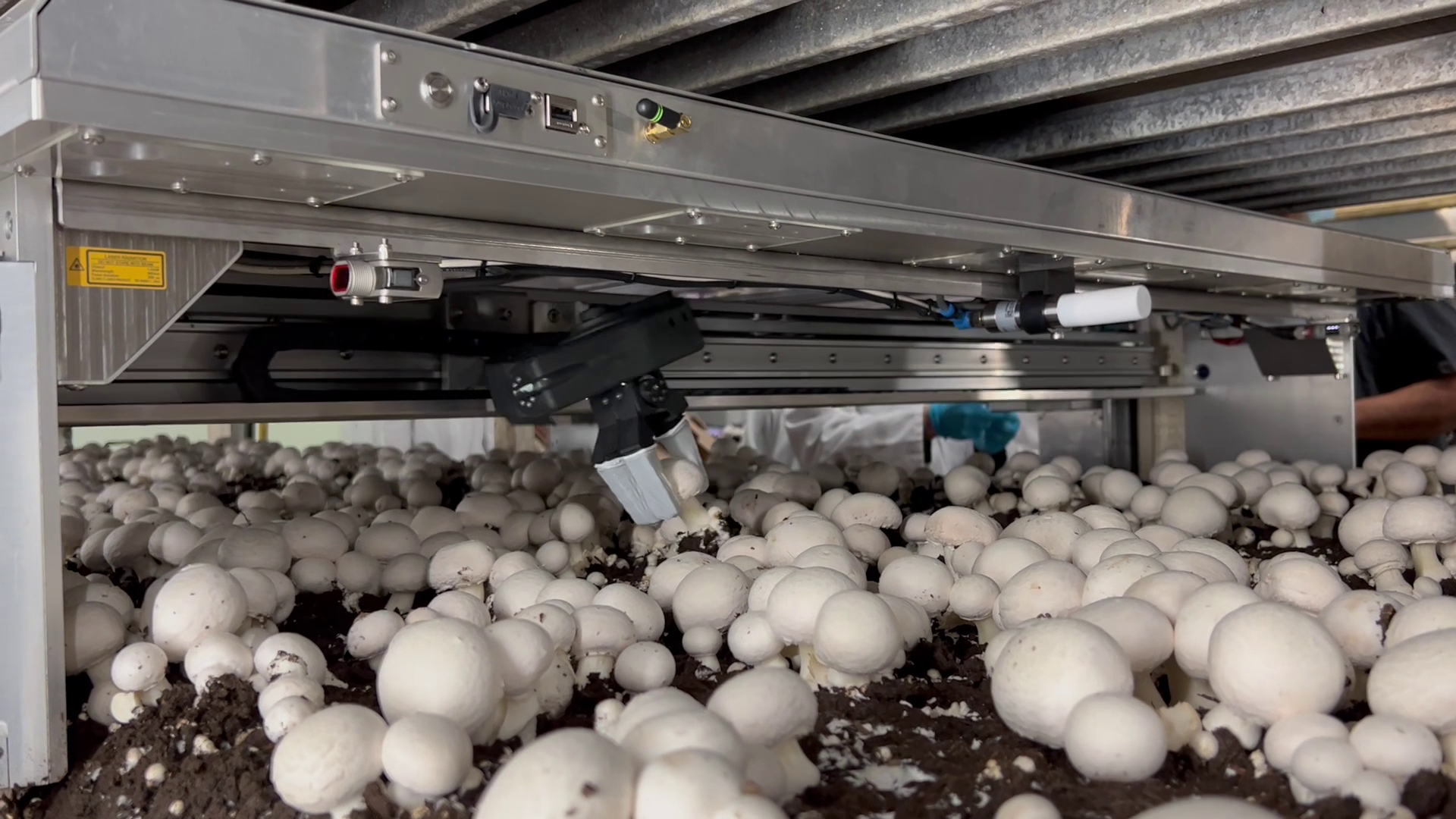
Proving it could be done
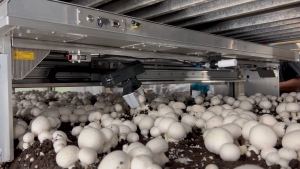
By 2022, Mycionics had achieved something many considered impossible. The company had developed a complete robotic harvesting system capable of picking, cutting, packing and stacking mushrooms within traditional Dutch aluminium shelving systems. Multiple robots worked together, sharing data and coordinating tasks throughout the growing rooms.
Technically, the challenge had been solved. The robots could harvest mushrooms around the clock, produce excellent quality, and successfully complete the full harvesting process.
Commercially, however, the breakthrough had not yet arrived.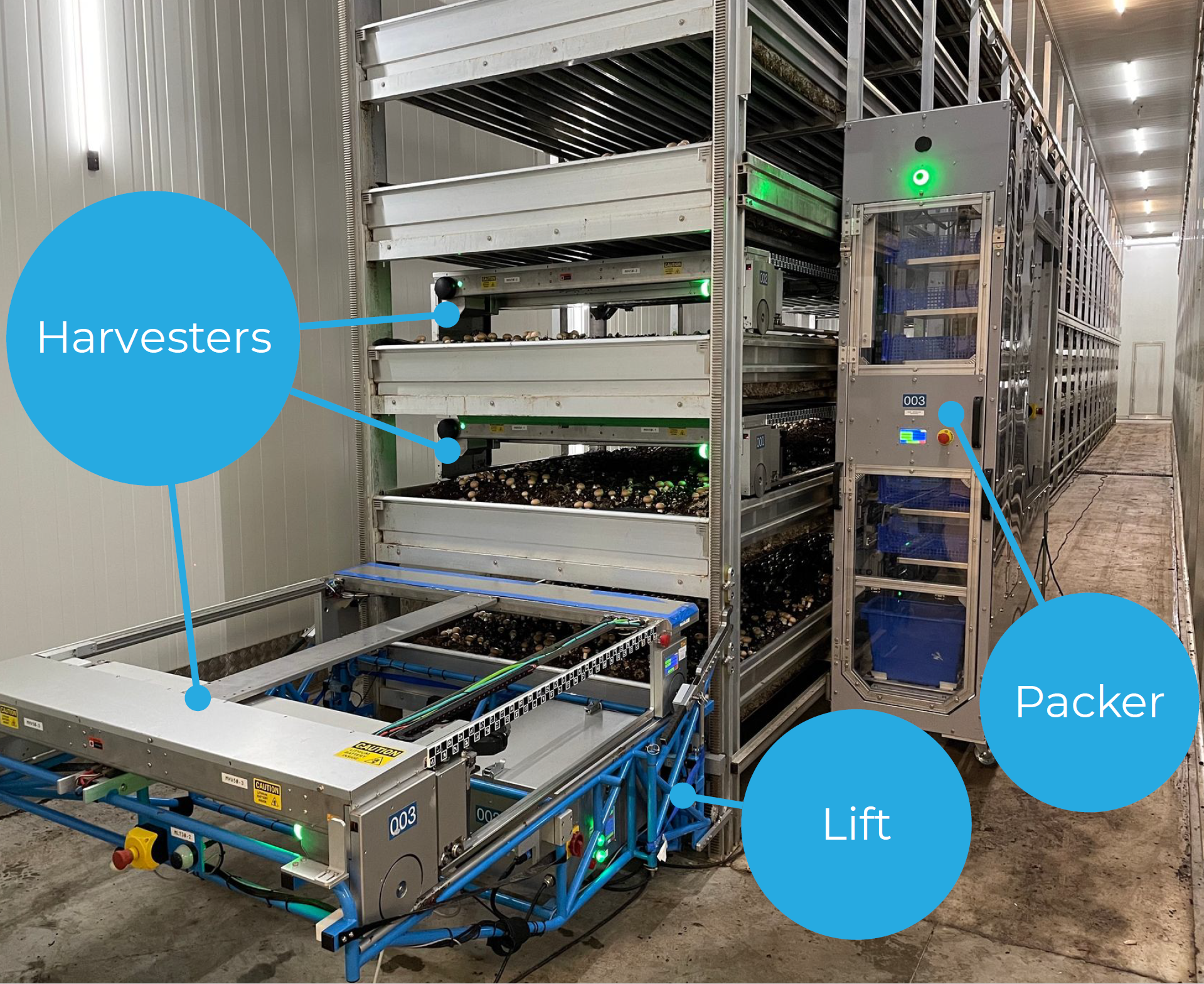
Despite the technological achievement, the systems were still not fast enough and not cost-effective enough to provide the breakthrough growers truly needed. 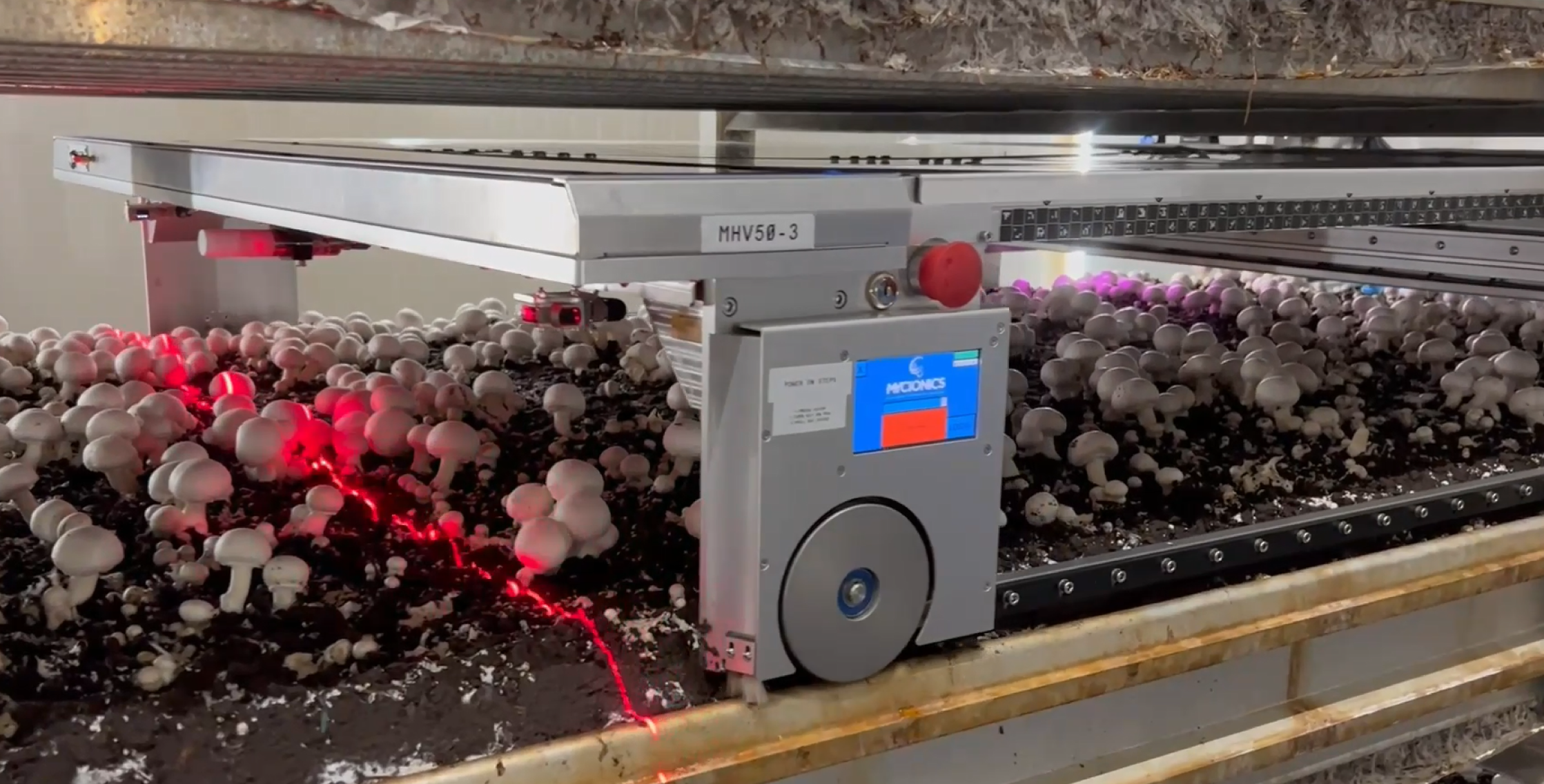
Many companies would have commercialised the system anyway. Mycionics chose a different path.
Starting over to move forward
In 2023, Mycionics chose to rethink its approach. Rather than pushing a solution to market simply because it worked, Stefan and his team stepped back and asked a different question:
What does the industry actually need? The answer was not full automation. The answer was smarter automation.
The team redesigned its technology around a hybrid model that combines the strengths of both people and machines. Robots focus on repetitive tasks such as harvesting, packing and handling. People focus on higher-value activities such as thinning, pruning, quality control and crop management. This approach dramatically improved the economics while maintaining flexibility for growers.
The company also modularized its entire technology platform, ensuring systems could be maintained by farm staff rather than requiring specialist technicians. In an industry where crops cannot wait, that distinction matters.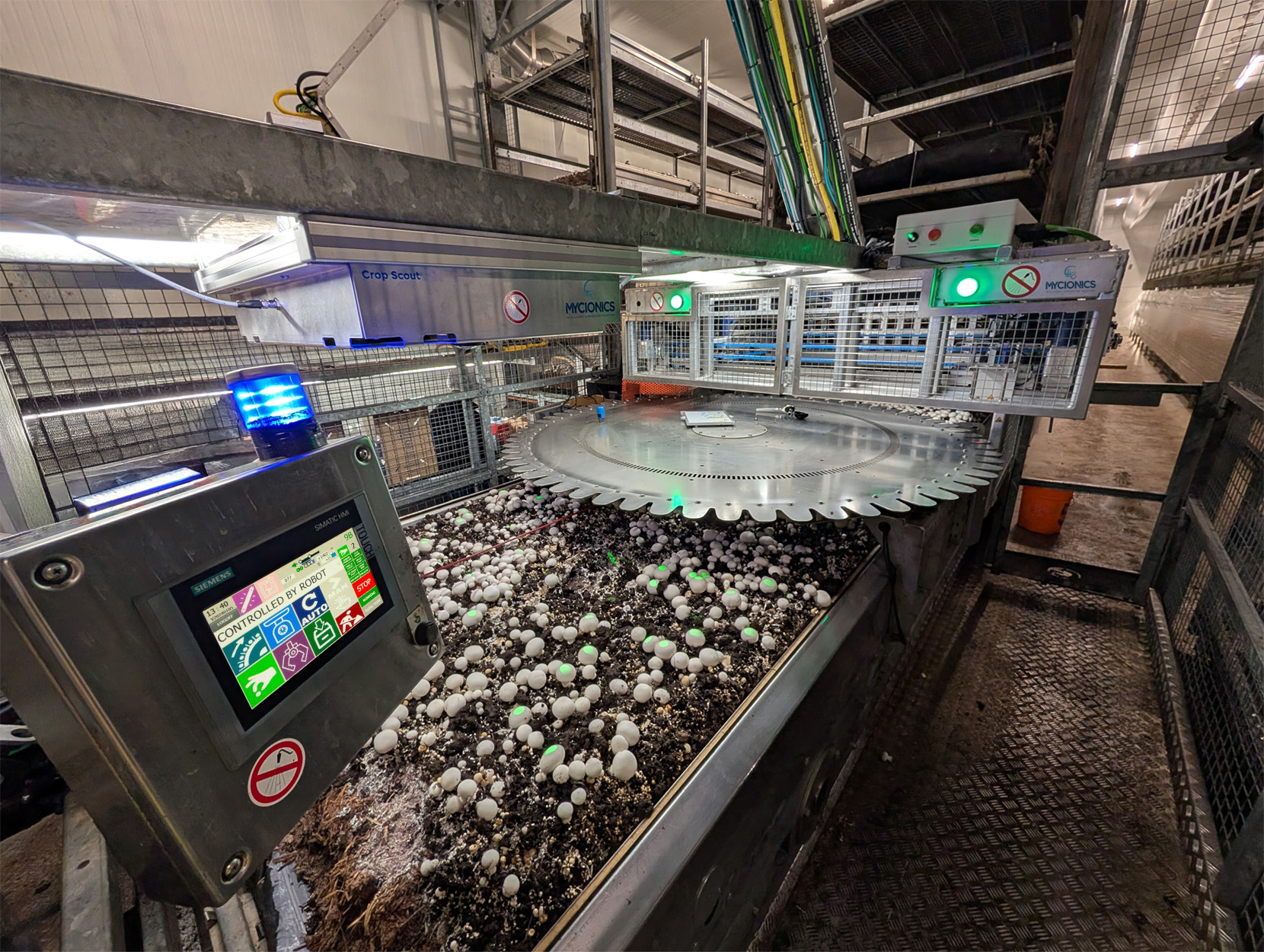
Today, Mycionics adapts its solutions to different farming infrastructures, including drawer systems and traditional Dutch shelving, each with different levels of automation depending on what makes the most practical and economic sense.
From robotics to crop intelligence
As the technology evolved, another opportunity emerged. Data.
The robots weren't just harvesting mushrooms anymore. They were collecting information.
Every mushroom scanned by a robot generates data. Every harvest creates new insights. Every growing cycle reveals patterns.
Mycionics realised that its vision systems could provide value long before a mushroom was ever picked.
This led to the development of Crop Scout and pointing systems that help growers track mushroom growth, optimize harvesting decisions and improve yields. The results have been significant.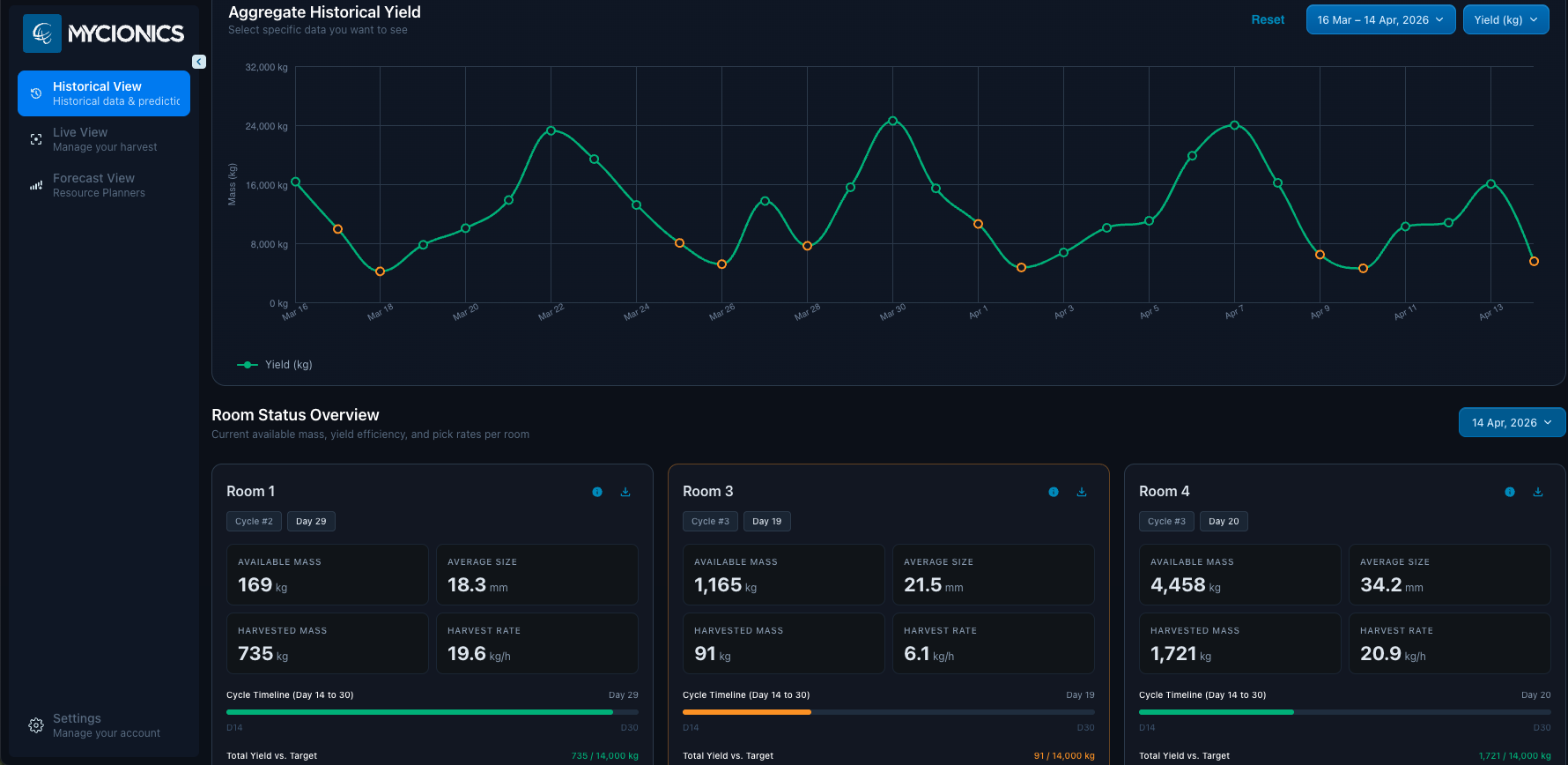
At South Mill Champs in Canada, the value of the technology became so apparent that the company purchased eighteen scanning and pointing units for deployment across its farm. According to Mycionics, the system is currently delivering an average yield improvement of 6.3 percent, representing approximately 23,000 additional pounds of mushrooms per unit annually. For growers, that is a meaningful impact.
Check out Mycionics Case study here.
Collaboration over competition
Throughout our conversation, one theme surfaced repeatedly: collaboration. Mycionics actively works with industry partners such as Limbraco and Christiaens to ensure technologies integrate seamlessly into existing farm infrastructures. Rather than trying to solve every challenge independently, the company believes the best solutions emerge through cooperation. That philosophy even extends to competitors.
Stefan speaks positively about other Canadian automation companies and believes that broader adoption of robotics across the industry benefits everyone involved. "If more farms successfully adopt automation, that's good for the industry."
It is a perspective that reflects the company's long-term mindset. Success is not measured by individual machines, but by the overall progress of the mushroom sector.
Looking ahead
Today, Mycionics continues to expand across Canada, the United States, Europe, Australia and New Zealand, while also attracting interest from South and Central America. The company is currently growing its team, adding new talent and preparing for the next phase of deployment.
Yet Stefan sees the future extending far beyond harvesting automation.
His vision is a connected mushroom industry where data flows between growers, compost suppliers, spawn producers, genetics companies, logistics providers and climate-control systems. A future where better information leads to better decisions, higher yields and a more sustainable industry.
The possibility of applying Mycionics technology to other crops may come one day. But for now, the focus remains firmly on mushrooms.
The company may be known for its robotics, but Stefan’s passion has never been about robots alone. It has always been about solving a problem worth solving.
That problem first took shape more than ten years ago, when Stefan, then a mushroom grower himself, began asking whether robotics could help secure the future of mushroom farming.
The answer wasn't built overnight.
It took thousands of tests, countless iterations and the willingness to start over when the first solution wasn't good enough. That mindset still defines Mycionics today.
Because building better robots has never been the company's ultimate goal. Building a stronger, more sustainable mushroom industry is.
Canadian agtech company Mycionics has introduced its newest innovation, the Crop Scout, now live at South Mill Champs Mushrooms.
The system scans each mushroom in real time and uses a green light to show harvesters exactly which ones are ready to pick.
By guiding workers to optimal mushrooms, Crop Scout helps farms achieve 4–8% higher yields and improves harvesting efficiency by around 15%. For an industry where labour and timing are critical, this selective approach can significantly cut waste and standardise quality.
The rollout was developed in partnership with South Mill Champs and Christiaens Group BV, marking another step forward in applying robotics and AI to commercial mushroom production.
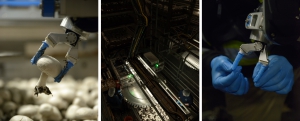
Mycionics, a Canadian-based pioneer in advanced mushroom harvesting systems, is announcing the launch of its robotic mushroom harvesting and scanning system with South Mill Champs, one of North America’s largest mushroom farms.
A rigorous six-month pilot proved the market’s first economically viable solution to the industry’s pressing labour challenges. Employing a hybrid harvesting approach enabled by the Christiaens Group’s drawer infrastructure, this technology allows humans and robots to work side-by-side on centralized platforms. The method leverages humans for their skill, and robots for their precision and stamina. With two robotic arms, the system harvested 33% of the crop with quality exceeding human harvesting, while also providing real-time crop insights that optimize growing and harvest decisions.
“Having lived through the complexities of robotizing traditional mushroom farms, I am confident in this new hybrid approach,” said Stefan Glibetic, CEO of Mycionics. “Now validated by South Mill Champs’ commitment to this large-scale deployment, it marks a new era for mushroom production.”
Deployment at South Mill Champs will occur in two phases. Phase one, beginning July 2025, will implement Mycionics’ scanning and pointing technologies farm-wide. These are projected to enhance harvesting efficiency by 15% and increase crop yield by 4-8% through guided labour and precision picks. This phase also includes demonstrating Mycionics’ next-gen robotic system, capable of harvesting 75% of the crop through robotic picking, packing, sorting, and grading. Phase two will fully populate the farm with robotics in 2026.
Mycionics is poised to transform the industry beyond North America. Following South Mill Champs’ lead, several farms in Europe have committed to adopting the technology, signalling strong international interest and the broad applicability of Mycionics’ solutions.
For additional information, visit mycionics.com or contact This email address is being protected from spambots. You need JavaScript enabled to view it.
The move comes at a time when the horticulture industry looks to accelerate its automation efforts to benefit Canadian growers.
Vineland Research and Innovation Centre (Vineland) has announced the transfer of its patented robotic mushroom harvesting technology to Mycionics, a Canadian agtech company located in Putnam, Ontario.
The move comes at a time when the horticulture industry looks to accelerate its automation efforts to benefit Canadian growers with Vineland uniquely positioned to contribute, given its innovative technology portfolio.
Under the terms of the agreement, Vineland’s intellectual property will be incorporated into Mycionics patent portfolio as they commercialize their mobile robotic harvesting system.
Please read the full article here.
Source: Greenhouse Canada





