 Mushroom Matter
sharing mushroom news with care
Mushroom Matter
sharing mushroom news with care
Menubar













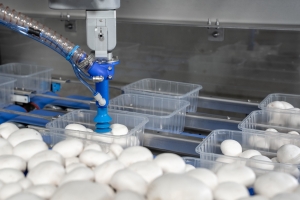
Labour availability remains one of the biggest challenges facing mushroom growers worldwide. While much of the industry’s attention has traditionally focused on automating harvesting, GTL Europe is now taking another important step in the process with its newly developed Packing Robot.
The system is designed to automate the transition from harvested mushroom to finished, ready-to-sell product. It forms the final link in GTL’s broader Swift Harvest concept, but can also be used independently by growers already working with GTL’s blue conveyor belt system.
From mushroom to punnet
Traditionally, packing still involves several manual steps. Mushrooms need to be assessed, sorted, weighed, trimmed where necessary and placed into the correct punnet or crate. GTL’s Packing Robot is designed to take over much of this work automatically.
After harvesting, mushrooms arrive at the robot without needing to be precisely positioned. Two vision systems guide the process. A first vision box integrated into the robotic arm identifies which mushroom should be picked next. While the mushroom moves towards the packaging, it passes a second vision system that assesses its quality, size and estimated weight, and determines whether the stem needs trimming.
Using this information, the system decides which punnet or crate the mushroom belongs in. If trimming is necessary, this is carried out immediately before the mushroom is placed into its packaging.
Vision technology makes the difference
An interesting aspect of the system is that mushrooms do not first have to be neatly arranged before the robot can handle them. Instead, vision technology continuously analyses the incoming product and determines the next action.
This may sound like a relatively small detail, but it is important for practical automation. Mushrooms are naturally variable products: they differ in size, shape and orientation. Being able to recognise and handle products while they are randomly positioned can simplify the flow between harvesting and packing considerably.
At the same time, automated inspection and handling should contribute to a more consistent final product and reduce unnecessary handling and product damage.
Part of a bigger rethink of harvesting
The Packing Robot becomes particularly interesting when viewed within GTL’s Swift Harvest concept.
Rather than treating harvesting and packing as two separate operations, Swift Harvest connects harvesting, product handling, cooling and automated packing in one integrated process. Mushrooms are harvested from the growing bed, transferred while maintaining their position, and can then move through cooling before robots select, trim and pack them.
Separating the moment of harvesting from the moment of packing could also give growers more flexibility in organising labour and production. Packing robots can continue processing product independently of exactly when the mushrooms were harvested.
First robot already in operation
GTL reports that its first Packing Robot has been operating successfully at a customer site since July 1, 2026.
And development is already moving further. The current machine works with GTL’s blue conveyor belt system, but the company is working towards a version that can pick mushrooms directly from the growing film and place them straight into the appropriate packaging without the intermediate conveyor belts.
For growers, that direction is perhaps the most interesting part of the development. Automation is increasingly moving beyond replacing one individual manual task. The focus is shifting towards redesigning the complete flow from growing room to packed product.
With labour pressure unlikely to disappear, technologies that combine product recognition, quality assessment and packing in one automated process may become an increasingly important part of the modern mushroom farm.
Read more about GTL and automating harvesting here.
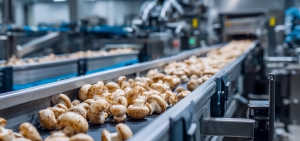
Automation in mushroom farming has long been discussed as a way to improve efficiency. What is changing now is the growing pressure behind it. Labour shortages, rising costs and increasing demands on consistency are making it more difficult for farms to rely on traditional harvesting and packing processes alone.
In many cases, labour accounts for a significant share of production costs, while at the same time becoming harder to secure. This is shifting automation from a long-term ambition to a more immediate consideration. Rather than focusing on full replacement, many growers are exploring how technology can support specific tasks and reduce dependency on manual work.
Developments like these suggest that automation is becoming less of an option, and more a necessary step in maintaining stable operations.
Please read the full article here.
Source: The Packer

What’s moving the mushroom industry right now?
What’s moving the mushroom industry right now?
The mushroom sector continues to evolve at pace. Automation, labour availability and cost efficiency remain dominant themes, while growers balance innovation with reliability on the farm floor.
Below are a few developments worth reading!
Hybrid harvesting, semi-automation and technology that works with biology
The mushroom industry continues to evolve as growers balance biological realities with technological progress. While automation and robotics have advanced significantly in recent years, the sector is increasingly recognising that the most effective innovations are those that support, rather than replace the biological and operational dynamics of mushroom cultivation.
Three developments are particularly shaping how growers approach technology today: hybrid harvesting, the return on investment of semi-automation, and systems that adapt to biological variability.
Together, these trends illustrate a shift away from the idea of fully autonomous farms towards a more pragmatic model of technological integration.
Hybrid harvesting as a structural solution
For many growers, hybrid harvesting is becoming a structural solution rather than a temporary transition phase.
Fully autonomous harvesting remains difficult in mushroom production because crops rarely grow in perfectly predictable patterns. Flushes vary in density, size and timing, making it challenging for robotic systems to match the adaptability and decision-making of experienced pickers.
Hybrid harvesting systems combine automated harvesting equipment with human labour, allowing technology to handle repetitive tasks while workers focus on quality selection and precision picking.
This approach allows growers to stabilise harvesting capacity during peak production periods while maintaining the flexibility needed to respond to crop variability. Instead of replacing labour entirely, automation becomes a tool that supports workers and improves overall operational resilience.
The ROI of Semi-Automation
While the concept of fully automated farms often attracts attention, many growers are finding that the most impactful investments come from semi-automation.
Technologies that support specific steps in the production process, such as climate control optimisation, grading systems, conveyor handling or partial harvesting automation, can deliver clear operational improvements without requiring massive infrastructure changes.
Semi-automation allows farms to modernise gradually while keeping systems manageable and adaptable. The focus is increasingly on measurable outcomes such as:
-
improved labour efficiency
-
reduced physical strain for workers
-
more consistent product quality
-
better production planning
As a result, growers are evaluating technology not only based on innovation potential but on practical return on investment. Systems that deliver stable performance and integrate well with existing workflows are often prioritised over more complex fully autonomous solutions.
Technology that adapts to biological variability
One of the defining characteristics of mushroom cultivation is biological variability. Even under controlled environmental conditions, each flush can develop differently in terms of growth speed, density and size distribution.
Historically, many technological solutions attempted to impose uniformity on this process. However, the industry is increasingly recognising that successful technology must adapt to biology rather than forcing biological systems into rigid production models.
New developments in sensor technology, climate control algorithms and data monitoring are helping growers better understand and respond to the dynamics of their crops.
By analysing environmental data and production patterns, growers can make more informed decisions about climate adjustments, harvesting timing and production planning. This approach allows farms to optimise yield quality and consistency while respecting the natural behaviour of the crop.
In this context, technology becomes a support system that enhances biological production rather than trying to override it.
A pragmatic path forward
The current direction of technological development in the mushroom industry reflects a broader shift towards practical optimisation.
Instead of focusing solely on breakthrough automation, many growers are prioritising systems that improve reliability, efficiency and operational flexibility. Hybrid harvesting, semi-automation and adaptive technologies all represent pragmatic steps that help farms manage labour challenges while maintaining high production standards.
As the industry continues to integrate digital tools, robotics and data-driven growing systems, the most successful innovations will likely be those that respect the complex biological nature of mushroom cultivation.
Looking ahead
In the next edition of Mushroom Matter Industry Insights, we will explore several additional developments shaping the sector, including:
-
data-driven mushroom farming and the role of sensors and AI
-
energy efficiency in mushroom cultivation
-
the next generation of harvesting robotics
These topics continue the conversation about how technology can support a resilient and sustainable future for mushroom production.
We’ll continue to follow these developments closely and share insights that matter to growers, farm managers and technology partners.
Published by Mushroom Matter: connecting the global mushroom community through insight, innovation, and inspiration





