 Mushroom Matter
sharing mushroom news with care
Mushroom Matter
sharing mushroom news with care
Menubar













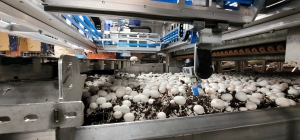
A turning point of Agtech Robotics
By Stefan Glibetic, Founder of Mycionics
For years, agricultural robotics was something the industry believed was just around the corner. Demonstrations appeared at trade shows, prototypes showed promising results, and early pilot projects hinted at what might eventually be possible. But widespread adoption remained limited.
Today, that situation is changing.
According to Stefan Glibetic, founder of Mycionics, the industry is now experiencing a rare convergence of forces that is pushing agricultural robotics from experimentation into real deployment. “We are experiencing a perfect storm where the technology is ready, the market is primed, and industry pressure is forcing farms to take calculated risks on automation.”
Technology has matured. Labour pressures continue to intensify. And the economics of automation are starting to make sense for real farms. Together, these factors are creating a moment that many growers feel is fundamentally different from anything the industry has seen before.
From fragile prototypes to farm-ready robotics
Only a few years ago, many agricultural robots struggled to survive outside controlled demonstrations. Machines could scan crops or perform basic harvesting tasks, but they were often too fragile or too complex to operate reliably in real production environments.
Mushroom farms are particularly demanding environments. High humidity, fluctuating temperatures and constant production pressure quickly expose weaknesses in delicate electronics and mechanical systems.
One of the biggest breakthroughs in recent years was not a new algorithm or a faster robot arm, but a shift in design philosophy. “The real breakthrough was making robotics farm-friendly. The machines had to survive real mushroom farms.”
Instead of trying to replicate every aspect of human behaviour in a single machine, robotics developers began focusing on systems that could perform specific tasks reliably within the realities of farm operations.
As a result, modern robotic systems are increasingly modular, rugged and easier for farm staff to maintain themselves. At the same time, they are being designed to integrate with both existing infrastructures and new facilities built specifically with automation in mind.
Early adopters also played a crucial role in this transition. A small group of growers were willing to invest in the technology before it was fully mature, helping developers refine their systems and prove that robotic harvesting could operate at real production speeds.
As those systems began working reliably on farms, skepticism in the industry gradually faded.
Labour pressure is reshaping the industry
Labour shortages are often described as the main driver behind agricultural automation. In reality, the problem runs deeper than a simple shortage of workers.
Mushroom harvesting is physically demanding work. Workers spend long hours bending over beds, harvesting quickly while maintaining quality, often in environments with high humidity and fluctuating temperatures. The work places strain on the body and requires sustained concentration.
As wages rise and workforce stability becomes less predictable, growers are facing a structural challenge. “The labour model itself is becoming unstable,” says Glibetic. “The margins of mushroom production simply cannot keep up with continuously rising labour costs for a job that fewer people want to do.”
Automation offers a different approach. Rather than eliminating human labour entirely, robotics allows farms to redistribute work.
Robots can perform repetitive tasks such as harvesting similar-sized mushrooms continuously and consistently. Human workers can then focus on tasks that require judgement, adaptability and crop knowledge, such as thinning, crop separation and yield optimisation.
Why mushrooms may lead the automation shift
Among agricultural sectors, mushroom production may be particularly well suited for early robotics adoption.
Unlike many crops, mushrooms are grown indoors and produced year-round. Farms operate twenty-four hours a day across all seasons, allowing robotic systems to be used continuously and improving their economic return.
In addition, many mushroom farms already operate within highly structured infrastructures. Dutch aluminium shelving systems, hydraulic lorries and modern drawer-based production systems provide the environmental consistency that robotics requires.
The greatest technological challenge was the crop itself.
Agaricus mushrooms are extremely delicate. Developing vision systems capable of identifying harvest-ready mushrooms and robotic grippers capable of harvesting them without bruising the crop required years of development.
Solving that challenge has made the mushroom industry an important proving ground for agricultural robotics.
Rethinking how farms approach automation
Even when the technology works, adopting robotics requires farms to rethink how their operations are organised.
One common mistake is attempting to fit robotics into existing workflows without adapting the farm environment.
“Automation works best when farms adapt their processes to the strengths of the machines,” says Glibetic. “Trying to force robotics into legacy workflows often creates unnecessary complexity.”
Another misconception is the idea that automation must replace all manual labour immediately.
In practice, many successful deployments start by automating smaller parts of the harvesting process and gradually expanding over time. This step-by-step approach allows farms to build experience while reducing operational risk.
Infrastructure also plays an important role. Older wooden tray systems were never designed with automation in mind. Modern infrastructures such as aluminium shelving or drawer systems allow robotics to operate more efficiently and at lower cost.
The risk of waiting
For growers considering automation, timing is becoming increasingly important.
Historically, technological transitions tend to reward early adopters. Farms that implement automation earlier often gain productivity advantages that translate into stronger margins and greater capacity to reinvest in further improvements.
“In many technology revolutions, the first twenty percent of adopters capture the majority of the long-term value,” says Glibetic.
Early adopters benefit from faster harvesting, improved crop quality and stronger operational efficiency. These advantages generate additional capital that can be reinvested into expansion and technology upgrades.
At the same time, waiting too long may create new challenges. As demand for robotics increases, supply chains for specialised equipment and farm infrastructure may become constrained.
Growers who delay adoption until automation is proven everywhere may find themselves competing for limited installation capacity.
The next phase: data and crop intelligence
Over the next three to five years, automation in mushroom harvesting is likely to expand rapidly, although the pace will vary between farm types.
Newly built drawer farms designed specifically for automation may operate with high levels of robotic harvesting, cutting, packing and conveyance. Existing shelving farms will likely rely more on hybrid systems where robotics and human labour continue to work alongside each other.
But according to Glibetic, the most transformative impact of robotics may not come from the machines themselves. “Robotics doesn’t just harvest mushrooms. It creates ground-truth data about every crop.”
For the first time, farms will be able to capture precise data about mushroom growth, harvest timing and environmental conditions across entire production cycles.
Until now, much of the information flowing through the mushroom industry has been indirect or incomplete. Robotics has the potential to create a closed feedback loop between growers, spawn producers and compost suppliers.
That data could unlock significant improvements in genetics, compost formulation and cultivation strategies.
And if those systems mature as expected, the impact could be substantial.
Glibetic believes the industry has not yet come close to reaching the full biological potential of the Agaricus crop. With better data and improved feedback loops across the supply chain, yield improvements of 20 to 30 percent may become achievable.
If that happens, the robotics transition in mushroom farming will be about more than automation alone. It could fundamentally reshape how the crop is grown and how the industry measures productivity in the years ahead.
If you want to learn more, feel free to contact Stefan Glibetic via This email address is being protected from spambots. You need JavaScript enabled to view it.





