








The partnership between Solmax and AgruniekRijnVallei shows why even a seemingly simple component can play an important role in an increasingly efficient and automated mushroom farm.
Some of the most important technology on a mushroom farm is easy to overlook.
A growing net is pulled through the production process again and again. It carries considerable loads, has to run straight and smoothly, and in some modern growing systems may be put to work every few weeks. A small difference in material, construction or finishing can therefore become significant over years of intensive use.
For Solmax and AgruniekRijnVallei (AR), that is exactly where an interesting partnership has developed. One company brings decades of expertise in weaving and materials; the other brings the product to the grower, adding confectioning, service and extensive practical knowledge of mushroom production.
The result is not simply a different way of distributing Nicolon® mushroom nets. It is a shorter connection between the people who make the material and those who use it every day.
Start with what you do best
When Örjan joined the horticultural activities at TenCate, what is now Solmax around four years ago, he began looking at how the company's mushroom materials reached the market.
AR was already selling Nicolon® growing nets and had been active in the mushroom sector for many years. What changed was the way the two companies began working together. Rather than maintaining a traditional supplier-dealer relationship, they gradually developed a partnership in which responsibilities, market knowledge and customer contact became much more closely connected.
Solmax is a global materials company with manufacturing operations around the world. Its expertise lies in developing and producing woven materials. But a mushroom grower does not buy a large roll of material and consider the job finished. The material needs to be converted into nets of exactly the right width and length. It needs to reach the farm when required. And if a net is damaged, someone needs to be able to assess whether it can be repaired.
Örjan saw an opportunity to organise that final part of the chain differently. Solmax has the expertise to develop and weave the material, but it is not set up to visit individual growers, take measurements, discuss the requirements of a particular growing system or provide local service when needed. “We weave. Weaving is our core business,” he explains.
Confectioning, measuring on site, made-to-measure delivery, repairs, distribution and direct contact with growers could therefore remain with a partner much closer to the market. AR already knew that market well; the difference was that the cooperation now developed into a much closer partnership.
Thirty years cannot be put on a specification sheet
The other half of the partnership becomes clear as soon as Pascal starts talking about mushroom growing.
He has been part of the sector for more than thirty years. After studying at the Mushroom Cultivation Vocational School in Horst, he worked in mushroom production himself before moving to the supply side of the business. Over the years, he travelled throughout the Netherlands, built relationships with growers and developed a detailed understanding of the systems in which the nets are used.
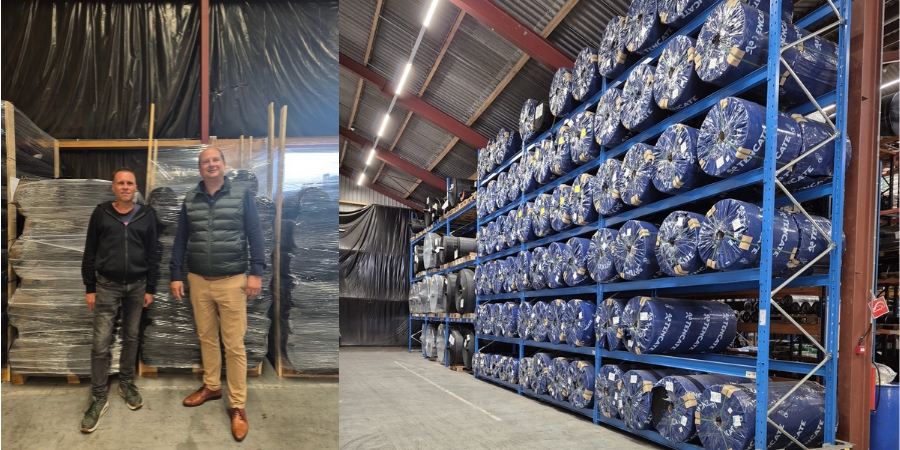
Today, AR receives Nicolon® material on large rolls and turns it into finished products for individual farms. If a customer needs one hundred nets of thirty metres in a particular width, that is what is produced.
During our visit to AR in Dreumel, Pascal shows us how much practical knowledge is involved in turning the material into a finished growing net. Material is measured, cut and finished accurately. Different growing systems require different dimensions. The length of a net influences the forces it has to withstand, while the frequency with which it moves through a system affects wear.
And when something goes wrong, the answer is not automatically to sell a new net. Some nets are worth repairing. With others, the labour involved would cost more than replacement. For Pascal, knowing the difference is simply part of knowing the customer and the specific needs. That knowledge is difficult to manufacture.
The feedback loop
This is where the partnership becomes more interesting than a conventional manufacturer-distributor relationship.
Pascal sees how the material behaves in practice. Solmax understands how changes in fibres and weaving influence its properties. Those two sources of knowledge increasingly feed into one another.
Örjan and Pascal visit customers together, travel together and discuss developments in the market. New materials are not only evaluated technically but also tested with growers under real production conditions. During our visit, they describe developments that have already been in practical testing for around a year and a half.
“We think together about the market,” Örjan says. He readily acknowledges that Pascal brings something different to the table. “He is much more technical and practical than I am.”
That difference appears to be precisely the point. The manufacturer does not have to become the local service company, and the service company does not have to become a materials manufacturer. Each contributes what the other does not have.
A net is not just a net
On the production floor, that becomes tangible.
Pascal shows us several Nicolon® constructions, referred to during our visit as the 303, 333 and 343 qualities. Depending on the application, additional high-strength Dyneema fibres can be incorporated into the construction.
Not every application needs the same solution. Longer nets can be exposed to greater forces. Adding more high-performance material can increase strength, but Dyneema is also expensive. Using it where it adds no practical benefit would therefore make little sense. The discussion is not simply about making the strongest possible net. It is about making the appropriate net for the application.
The partners are also working on further developments. Laboratory testing is combined with trials at mushroom farms before decisions are made about introducing a new construction more widely.
According to Pascal, growers also notice practical differences in how the material behaves. He describes the Nicolon® nets as smoother and easier to pull, something he relates to the way the material is woven. In his experience, that can matter during filling and emptying and in keeping a net running correctly through the system. It is a reminder that performance is not defined by one number on a technical datasheet.
Let the grower decide
Both men make no secret of their confidence in Nicolon®. Pascal in particular is convinced of its quality. But interestingly, his preferred way of proving that is not by talking down competing products. Quite the opposite.
Pascal is careful to point out that other products have their own specifications and that growers may have long-standing relationships with other suppliers. His argument is simpler: let them experience the difference. “Just try it.”
In the Netherlands, the mushroom sector is small enough for experiences to travel quickly. Growers know one another. They see what colleagues are using and hear what works and what does not. That makes trust more valuable than a hard sales pitch.
“You have to stay honest with people,” Pascal says. And that also means not selling something simply because you can. If a net can be repaired economically, repair it. If an expensive construction is unnecessary for a particular application, there is little reason to recommend it. For Pascal, that is not separate from sales. It is how long-term sales relationships are built.
When every two weeks becomes normal
At the same time, the environment in which these nets operate is changing.
Mushroom farms are becoming larger, labour is more expensive and production systems are being designed for greater throughput. In some systems, nets are pulled in and out considerably more frequently than they once were.
Pascal gives the example of a system in which nets can be used every fourteen days. Compare that with a system where the same operation takes place once a month or less, and the difference in lifetime loading becomes obvious. “It is all friction.”
In practice, they encounter growing nets that remain in use for many years, sometimes around a decade or even longer. But age alone says relatively little. A net's working life depends heavily on how intensively it is used and in which system.
Automation is likely to increase those demands further. During our conversation, the discussion moves naturally towards robotic harvesting and increasingly automated growing systems. Neither Pascal nor Örjan claims to know exactly what the mushroom farm of the future will look like.
But they do not expect the growing net simply to disappear tomorrow. As long as substrate still needs to move through growing systems, nets continue to have a role. What is changing is what growers expect from them: reliability, predictable performance and compatibility with processes in which downtime and unnecessary handling become increasingly expensive.
Trust does not stop at the Dutch border
The same philosophy is now being taken further internationally.
Solmax already operates globally, while the mushroom sector works through networks of distributors, suppliers and local representatives. In the final part of our conversation, Örjan describes how enquiries from markets such as Poland are discussed with existing partners rather than simply being pursued independently. Other international markets are served through distribution and logistics partners, while Pascal and Örjan also travel together to develop opportunities.
An important part of this international network is Sylvan, with whom both AR Plant and Solmax maintain a particularly close relationship. Sylvan plays a key role in the worldwide marketing and distribution of Nicolon® growing nets to end users across international markets. This cooperation is exclusive: Sylvan distributes Nicolon® growing nets exclusively, further strengthening the connection between manufacturing expertise, local service and growers around the world.
That requires clear agreements, but both return repeatedly to something less formal: trust. A contract can define territories and responsibilities. It cannot create a functioning partnership on its own. The communication between manufacturer, AR, distributors and growers therefore matters as much as the physical movement of the material.
The value around the product
Perhaps that is the most interesting lesson from looking closely at the role of a growing net within modern mushroom production.
Solmax could simply manufacture material. AR could simply cut and sell it. A distributor could simply move it from one country to another. But modern mushroom production increasingly demands more than a chain of individual suppliers.
A manufacturer needs feedback from the growing room. A grower needs someone who understands the application. New materials need to be tested outside the laboratory. And when something goes wrong, somebody has to take responsibility rather than point further down the supply chain.
That is where the partnership between Solmax and AgruniekRijnVallei has found its strength. Solmax brings material technology and manufacturing expertise. AR adds confectioning, speed, service and decades of practical mushroom knowledge. International partners extend that combination into other markets. And information travels back in the opposite direction.
The Nicolon® growing net sits in the middle of it all. And the closer you get to the mushroom farm, the clearer it becomes that its real value is not only woven into the material. It is also woven into the knowledge, service and trust around it.





