 Mushroom Matter
sharing mushroom news with care
Mushroom Matter
sharing mushroom news with care
Menubar












What’s moving the mushroom industry right now?
Technology is becoming smarter and more connected
In our previous edition of Mushroom Matter Industry Insights, we explored how hybrid harvesting, semi-automation and technologies that work with biology are helping growers build more resilient production systems.
The next step in this evolution is not necessarily more automation, but smarter integration.
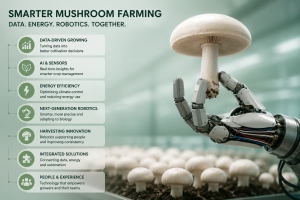
Across the mushroom industry, data, energy management and robotics are increasingly working together to help growers make better decisions, improve efficiency and optimise production. Rather than operating as separate innovations, these technologies are becoming part of one connected production strategy.
Below, we explore three developments that are shaping the next phase of mushroom cultivation.
Data-driven mushroom farming: turning information into better decisions
Modern mushroom farms generate more data than ever before.
Climate computers, sensors, cameras and monitoring systems continuously collect information about temperature, humidity, CO₂ levels, airflow and crop development. But collecting data is only the beginning.
The real value lies in translating that information into practical decisions.
Increasingly, growers are using data to optimise climate settings, predict crop development, improve harvest planning and identify trends that would otherwise remain unnoticed.
Artificial intelligence is also beginning to play a role, not by replacing experienced growers, but by supporting them. AI can recognise patterns across multiple growing cycles, helping growers respond more quickly and consistently to changing conditions.
The combination of digital insights and human expertise is becoming one of the strongest drivers of production efficiency.
Energy efficiency is becoming part of the growing strategy
Energy remains one of the largest operating costs in mushroom production.
Climate control, ventilation, cooling and heating are all essential for producing a consistent crop, but they also account for a significant share of production expenses.
Rather than treating energy efficiency as a sustainability project alone, many growers now view it as an integral part of crop management.
Optimising climate recipes, recovering heat, improving ventilation strategies and reducing unnecessary energy consumption all contribute to lower operating costs while maintaining crop quality.
The objective is no longer simply to use less energy, but to use energy more intelligently.
The next generation of harvesting robotics
Robotics continues to evolve rapidly, but expectations within the industry are becoming more realistic.
Instead of aiming for fully autonomous harvesting under every condition, today's developments focus on improving precision, flexibility and collaboration with human pickers.
Advances in computer vision, artificial intelligence and gripping technology are enabling harvesting robots to better recognise mushroom maturity, size and position. At the same time, robotics is expanding beyond harvesting into grading, packing and logistics.
These developments allow growers to automate repetitive tasks while maintaining the flexibility needed to deal with biological variability.
Rather than replacing people, the latest generation of robotics is designed to support the entire harvesting process.
Connecting the dots
Although data, energy management and robotics are often discussed separately, their greatest value lies in how they reinforce one another.
Data helps growers understand what is happening inside the growing room.
Energy management ensures the crop develops under the most efficient conditions.
Robotics helps translate those growing conditions into a more consistent and efficient harvesting process.
Together, these developments are creating mushroom farms that are not only more productive, but also more resilient and better prepared for future challenges.
The bigger picture
From our conversations with growers, suppliers and technology companies across the global mushroom industry, one trend is becoming increasingly clear.
Innovation is moving beyond individual technologies. The strongest solutions are those that combine biology, practical experience and digital tools into one integrated approach.
Rather than asking "Which technology should we invest in?", growers are increasingly asking "How do these technologies work together to improve our farm?"
At Mushroom Matter, we believe this shift towards connected thinking will define the next generation of mushroom production.
Looking ahead
In the next edition of Mushroom Matter Industry Insights, we'll once again take a step back from the daily headlines to explore the developments shaping the future of the global mushroom industry.
We'll continue to connect the dots between innovation, cultivation and market developments, bringing together the stories and trends that matter most to growers, suppliers and technology partners.
Published by Mushroom Matter: connecting the global mushroom community through insight, innovation and inspiration.
In a previous edition of Mushroom Matter Industry Insights, we highlighted a shift towards more pragmatic and integrated approaches to technology in the mushroom sector.
In this edition, we take a closer look at three developments that are gaining momentum across the industry:
- data-driven mushroom farming
- energy efficiency strategies
- the next generation of harvesting robotics
Together, these topics show how the sector is moving towards smarter, more efficient and future-proof production systems.
From intuition to data-driven growing
Mushroom cultivation has always relied heavily on experience and intuition. Skilled growers understand their crops by observing subtle changes in growth, climate and timing.
What is changing today is not the importance of that experience, but how it is supported.
Sensor technology and data platforms are increasingly being used to monitor:
- temperature and humidity at multiple levels
- CO₂ concentrations
- airflow and microclimate differences within growing rooms
- growth patterns across flushes
This allows growers to move from reactive adjustments to more predictive decision-making.
Instead of asking what is happening now?, the question becomes:
what is likely to happen next and how can we anticipate it?
Artificial intelligence and data models are slowly entering the sector, but their role is still supportive rather than leading. The real value lies in combining data insights with grower expertise.
The farms that benefit most are not those with the most data, but those that know how to use it in a practical way.
Energy efficiency as a strategic priority
Energy has become one of the most critical cost factors in mushroom production.
Climate control, ventilation, cooling and heating all require significant energy input, making efficiency a key focus area for growers.
Across the sector, several strategies are emerging:
- optimising climate recipes to reduce unnecessary energy us
- improving insulation and air handling system
- recovering and reusing heat where possible
- exploring alternative energy sources
What stands out is that energy efficiency is no longer treated as a standalone project.
It is increasingly integrated into overall farm strategy, where climate control, yield optimisation and cost management are closely linked.
For example, small adjustments in climate settings can reduce energy consumption while maintaining — or even improving — product quality.
This makes energy efficiency not just a sustainability measure, but a direct driver of profitability.
The next generation of harvesting robotics
Robotics continues to be one of the most visible areas of innovation in the mushroom sector.
However, the narrative is shifting.
Where earlier developments focused on full automation, the current generation of harvesting robotics is becoming more refined, adaptive and realistic in its application.
Key improvements include:
- better vision systems for detecting size, maturity and position
- more precise picking mechanisms
- improved ability to handle variability within flushes
At the same time, expectations are becoming more grounded.
Fully autonomous harvesting remains complex due to the biological variability of mushrooms. As a result, many solutions are designed to operate within hybrid systems, supporting human pickers rather than replacing them entirely.
Robotics is increasingly seen as:
- a way to stabilise capacity
- a tool to reduce physical strain
- a solution for specific bottlenecks in the harvesting process
The question is no longer can robots replace people?, but
where do robots add the most value within the process?
Connecting the dots
What links these three developments is a common direction: smarter integration.
- Data helps growers make better decisions
- Energy strategies improve efficiency and sustainability
- Robotics supports labour and stabilises operations
None of these developments stand on their own.
Their real impact emerges when they are combined into a coherent production strategy.
This reflects a broader shift within the industry, from isolated innovation to integrated optimisation.
A realistic path forward
The mushroom sector is not moving towards a fully automated future overnight.
Instead, it is building a more balanced model, where:
- technology supports biology
- data supports decision-making
- automation supports people
This approach may be less visible than bold innovation headlines, but it is far more effective in practice.
Looking ahead
As these developments continue to evolve, the focus will remain on practical implementation and real-world impact.
In the next edition of Mushroom Matter Industry Insights, we will explore several additional developments shaping the sector, including:
- labour strategy and workforce sustainability in mushroom production
- shifting market demand and the role of specialty mushrooms
- collaboration across the value chain
These topics continue the conversation about how the industry is adapting, not only through technology, but also through people, positioning and partnerships.
Published by Mushroom Matter: connecting the global mushroom community through insight, innovation, and inspiration





