














As most growers know, our mushroom is a slow-growing and very sensitive organism. It is very susceptible to changes to its environment, growing substrate, or competitors. Whether it is just the nature of the fungus or the fact that our mushroom is such a slow-growing organism, it is extremely sensitive to environmental or nutritional stress. Most likely, it is a combination of the two.
The only time in the mushroom's life cycle during which it grows quickly is during the rapidly expanding stage of the pin development. During this time, it becomes even more sensitive to environmental or crop-management changes. The final fresh mushroom quality characteristics are greatly influenced during this, what I call, the Rapid Expanding Stage (RES).
At the end of this developmental stage, just before harvesting, the mushroom pumps most of its food and water from the compost into itself over about 24 h. To efficiently accomplish this incredible task, the mycelium and rhizomorphs in the compost and casing must be properly created and maintained. Therefore, it is critical to establish an efficient system for the creation, adsorption, and movement of food and water during the composting, spawn growing, and case run periods.
Furthermore, because the mushroom is so sensitive during the RES, the grower must maintain a steady environment and watering management scheme.
Fresh mushroom quality involves every detail and every person from Phase I through packaging. The primary goal of the mushroom grower seeking optimal fresh quality is to create a substrate, environment, and growing conditions that reduce stress on the sensitive mushroom.
The mycelium in the compost absorbs nutrients during the spawn growing period, then begins to pump them up into the mushrooms during pinning and harvesting. Therefore, Phase I and II composting becomes the critical component to enable the mushroom to efficiently adsorb and pump the food and water. It is the grower’s responsibility to “prime the pump” for the mushroom.
After casing, the goal is to create and maintain proper rhizomorph formation to efficiently transport water and nutrients into the mushroom, especially during the RES.
The late Dr. Jim Sinden described this transport of dissolved nutrients from compost through the casing to the developing mushroom as a 'pipe system'. The spawn growth in compost creates a “pipe system” for the movement of food and water, and the rhizomorphs in the casing are larger “pipes” designed for the rapid transportation of nutrients and water.
Several factors for improving the pipe system include balanced compost nutrition, proper temperatures, and optimum compost and casing moisture. Alternatively, those factors interfering with the pipe system, such as insects, nematodes, bacteria, viruses, or fungi, must be controlled.
The most critical factor is casing moisture, which is necessary to keep the pipes feeding the mushroom in good working order.
The most critical stage of the mushroom’s development is during the RES, where the mushroom doubles in size every 24 hours. This expansion stage depends on compost temperature, compost moisture, and casing.
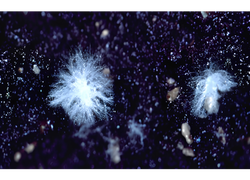
The mushroom expends a tremendous amount of energy to rapidly biosynthesize and transport essential structural components, such as mannitol. This flow of nutrients is occurring at a rapid rate during the RES of the mushrooms' development, and the efficiency of this nutrient and water transportation is dependent on the type and quality of the rhizomorphs in the casing layer, Figure 1.
It is the grower's responsibility to manage the casing so that rhizomorphs are well constructed and maintained.
 Figure 1. Proper rhizomorph formation is critical for the flow of water and nutrients into the developing mushroom.
Casing Management
The function of the casing layer is, quite simply, to trigger the mushroom to switch from vegetative to reproductive (fruiting) growth. The casing also functions to supply and retain moisture for the mushroom, and the rhizomorphs transport dissolved nutrients to the mushrooms.
The Water Holding Capacity (WHC) is often described as an important characteristic of the casing layer, and it is, in fact, a valuable fact to know about your casing material. Another harder-to-measure, less well-known factor is Water Availability (WA), which describes how readily water is released from a substrate.
As far as a mushroom is concerned, it is the water giving up ability, not water holding capacity, that characterizes a good casing substrate.
A continuum of common casing materials that have the most to least WA would be something like:
Soils > Spent Mushroom Substrate > Black Peats > Sphagnum Peat
The synthetic gels or polymers, although they hold more than 10 times their weight in water, have a very poor water-giving-up ability. pH buffering materials, like sugar beet lime or marl, may help to increase the water-giving-up ability of sphagnum peats.
What is important to remember is that the better the WA of the casing material, the more efficient the rhizomorph system that is likely to form, and the easier it is for the grower to maintain this pipe system during production.
Insects, pests, nematodes, bacteria, virus, and Trichoderma are some of the more common pests that interfere with an efficient pipe system.
Mushroom Size
Mushroom size is primarily determined by the number of pins that develop at a break or flush. After that, size can be influenced by how the crop is prepared and managed, and if the room’s environment will maximize mushroom size.
This crop management must occur earlier, not later, because once the pins are “pea-size,” it has already been determined how big the mushroom will get, and it’s too late to influence the outcome.
The best Portobello growers are those who have learned to manage the pin set to achieve enough pins for a good yield, but more importantly, only the right amount of pins to produce the largest mushrooms for their Portobello market.
Other factors affecting size include casing depth and moisture. As these two factors increase, so does size, but there is an economic limit to how deep the case can be and its influence on size.
Compost moisture, as normally encountered at most farms, will not influence size, but has more influence on fresh quality. It has been reported that adding spawn supplements to a moist compost will increase yield and size, whereas adding them to a dry compost will only increase yield.
Environmental manipulation of temperature, humidity, air flow, and CO2 also influences pin development. However, there is disagreement among growers and researchers over whether high or low humidity levels or the evaporation rate influence pin development.
Either too high or too low relative humidity after flushing will negatively influence pinning or pin development, and thus mushroom size.
Compost dry weight is closely related to mushroom size. The more compost that is filled per ft² or m² at spawning or casing time, the larger the mushrooms.
However, this phenomenon is more involved than just the amount of food per area. It has been reported that low dry weights with more supplements added at spawning will increase yield but not mushroom size.
Some say the earlier the crop is cased, the smaller the mushrooms, while others have suggested just the opposite.
Obviously, the timing of the water application affects the number of pins that develop, thereby influencing mushroom size. Water management during flushing, clumping, primordia formation, and pinning will determine the mushrooms' size.
A general rule of thumb is that the earlier one waters after flushing, the fewer pins that form, increasing mushroom size. However, watering later when all the pins have fully developed will improve yield, but the mushrooms will be smaller, Figure 2.
When casing is too dry going into a break and is not receptive to water after a break, normally the mushroom size for that break will be smaller.
Once the pins are well developed (larger than a peppercorn), their size has been set, and most of the water given to the casing after that is for the next break or flush of mushrooms.
Figure 2. When water is applied at the different pin stages shown below, it has different influence on yield and size. Watering earlier (towards the left), yield will decrease but mushroom size will be increased. Watering later (towards the right), maximum yield will be achieved, but with smaller mushrooms.